Monday 14th May 2007 Crayfish Camp Site.
We went off on our own, exploring and came across a flower farm and went to the gate and asked to visit their geo-thermal power station. After some sweet-talking (They NEVER allow this!!) the GM agrees, and took us around himself. It was interesting to hear they get steam from 2.15Km beneath the earth and pipe the heat thus generated all around the estate to heat the roses in the tunnels. He then took us to the power station which 2,05Km deep where they extract the steam at 143deg C, at 6bar pressure, and heats pentane liquid to drive the turbines and generates 1,3MegaWatts of electricity which is all used on the farm to drive the pumps and fans and cool rooms etc. The whole place including the tunnels are computer controlled. The power station cost R100mil to set up and they hope to pay it off in 4,5 years.
We continued our drive around Lake Naivasha, unfortunately parking under some roosting cormorants to watch the flamingos and other game, and drove off with a polka spotted tent which smelled like fish!!
We found another small game reserve with water in the extinct crater lake. It’s pH11.5 is very alkoline and the Maasai name for it is ‘castrated bull’, because it is as useless, not having any fish. However the flamingoes love the spirollina algae which cause the water to be emerald green. Continuing around the lake we found commercial dairy, crop and flower farms with many pivots irrigating from the lake. Back at camp we found the rest of the group had spent the whole day in camp. The evening was spent bird-watching on the tranquil lake shore until we had to leave as the hippo wanted to come shore to graze, and we had to make way.
Sunday 13th May 2007 Crayfish Camp Site
We went through the border into Keya, with a transit visa costing US$20 each with no problems. Kenyan side looked like a young Transkei with the overgrazing causing erosion and desertification already setting in. Apart from the very potholed road we arrived at Nairobi and were amazed at how much construction was going on. Kenya is obviously a much wealthier state than Tanzania which is better than Zambia. The traffic is another thing altogether. We though Dar es Sallaam was bad. In Nairobi they were creating 4 lanes in one direction on a two-way road! Traffic approaching, just had to wait. This was a Sunday afternoon and we had never seen so many large trucks on the road, ever! We arrived at Lake Navaisha at Crayfish Camp Site.
Lake Navaisha is part of the Rift Valley Lakes 2000m above sea level and half a degree South of the equator, and very cold. The Lake is surrounded by huge Cut-flower exporting commercial farms. There are thousands and thousands of tunnels with mostly roses, carnations, lizianthus and other flowers.
Today was first day since leaving South Africa that the sun did not shine at all, all day.
Saturday 12th May 2007 Marerani
We were only allowed to stay in the crater for a maximum of 6 hours to prevent congestion and disturbance of the animals, but it was sufficient time to see everything. The crater floor is 23Km diameter and averages 600m deep from the rim, has over 20 000 grazing animals and the largest concentration of predators per Ha in the world. It didn’t disappoint us. As the animals are habituated to vehicles, we could get really close to them without disturbing their activites.
We arrived back at Barry’s place just in time to watch the rugby. Barry and Lynne had not only looked after our vehicles for us, but had spit-braaied wildebeest and warthog for us, and we all celebrated the Shark’s win that evening. Barry and Lynne still support the Sharks and listen to Radio Jakaranda all the way from SA.
Friday 11th May 2007 Gorongoza Crater Lodge
After an early hearty breakfast we set off further north into the Serengeti which means “endless plains” in Maasai. This was where the expected teaming herds of buffalo, zebra and wildebeest had migrated on their way to the Masai Mara game reserve in Kenya following the grass. The continual calls from the gnus and zebras filled the air. The the radio told us about the leopard so off we wizzed to a large yellow Fever tree in which the leopard was supposed to be. It must have been funny to see 8 people sticking out of the top of the Cruiser staring at a blatently vacant tree. Within minutes there were four other vehicles with their occupants doing the same thing. Eventually I spotted the leopard in a nearby green tree, almost invisible between the leaves. It was a positive spotting and lots of jokes were thrown around about it being a painting of a leopard. Livingstone said we were lucky that we had visited the park out of season because those four other vehicles would have been 200 in a matter of minutes during peak season.
After lunch we traveled to Ngorogoro Crater Lodge which was just as spectacular as the previous hotel. Every room overlooked the whole crater floor. We were lucky to see the view because the next morning it was totally covered in mist and was drizzling and very very cold. The was a huge very welcome roaring fire in the fireplace.
Thursday 10th May 2007 Seronera Lodge
Bright and early the driver/guide “Livingstone” arrived in a Toyota Landcruiser with 8 passanger seats. We couldn’t believe, once we had set off that Landcruisers had such low power, although it had a 4.2l diesel engine!! It took us a full morning to the entrance to the Serengeti Conservation area which included Ngorogoro Crater and a huge Maasai pastural area. The Maasai cattle were allowed to graze in the conservancy and even water their cattle in the crater. The conservancy area is overgrazed, of course due to the pressure of the cattle and goats. Having had our minds geared for hot weather, being 4 degrees from the equator and having always thought that this was a hot area some of our crew only took shorts and it was unbelievably cold!!!
After the hype about Serengeti we were disappointed in the amount of game we saw. We had to make a huge paradigm shift from the usual looking FOR game to looking AT game!! All the drivers I the park are in radio contact and we were surprised to be told “Now we go to see lion/cheeah/leopard etc” We were peering through binoculars at a group of rocks for the expected cheetah which we couldn’t see there until someone turned round and it was on the other side of the vehicle in the grass with two little cubs. Then off we shot to find the ‘lion in the rocks’ and found it hiding in the bush on the rocks. Then Nev spotted a single lion in a ditch, but Livingstone wasn’t interested because he had been told there was a group of lions next to a water hole a little further. So we sped off to see those instead. Once we changed our attitude it was quite fun saying ‘what are we going to see next Livingstone?’
Finally we arrived at the lodge, a magnificent hotel built around and into the rocks on a koppie. This was pure luxury for us after having camped for two months. After a full buffet dinner we suffered from bloat.
Wednesday 9th May 2007 Meserani
We met up with the other four who had located a friend from South Africa, Barry and Lynne Bales who run a campsite 30Km outside Arusha. They have a wonderful Maasai museum and excellent snake park there, and Barry also has a workshop where he maintains the vehicles for overland safaris. Our spare wheel holder had cracked and Barry fixed it, and while talking to him we found that he had farmed at Donnybrook, and had gone to Weston!!! When he found out Nev had also gone to Weston he refused payment for the work done because Nev was also and old Weston boy. Brian and Willy had both bad experiences in Arusha when someone had broken three of their door locks while were shopping. Nothing was stolen, miraculously. Dave and Bryl went to the internet café in Arusha in the afternoon and someone started to remove their 4-wheel-drive hub while Beryl was sitting in the car!! They had taken 5 of the 7 bolts off before a policeman disturbed them.
Barry persuaded us to go on an organized safari to Serengeti and Ngorogoro Crater and it would be much cheaper than doing it on our own because we had foreign registered vehicles. We reluctantly agreed and prepared to leave the next morning.US $390 each. However, it turned out for the best, as we would never have seen what we did see, and it would have cost us twice as much. on our own.
Tuesday 8th May 2007 Colobus Camp
We left Merangu with Dave and Beryl and went to Arusha National Park. We were still fascinated by the rapid contrasts of Marandgu’s Tropical flora of huge bananas, pineapples, tomatoes etc where is rained almost every day during the night and was extremely fertile and lush, and 5Km away the mealies were all shriveled from drought and there is virtually Karroo vegetation. Marangu was at 2000m above sea level, and the drought area was at 1400m.
We continued via Moshi to Arusha park and noticed mountains being’ carved out’ and on closer inspection we discovered that the local people make their own concrete blocks by carving them out of the soft red stone of the mountains for building their houses.
$110 for 24hours was the asking price to enter the reserve. We saw a lot of animals and saw our first troop of black and white colobus monkeys. They have long white hair on their backs which, combined with their white hairy tails looks like they have a snow white hairy blanket on their backs. We have subsequently seen other colobus monkeys (including a little albino baby) and they were not nearly as stunning as those in Arusha Game Reserve. We then drove up a steep rocky road to a viewing point at 2500m half way up Mt Meru, the 5th highest peak in Africa. Looking towards where Mt Kilimanjaro was covered in cloud we felt on top of the world……until we turned and looked behind us at the mountain towering another 2000m above us. Elephant buffalo and bushbuck live up there, and although 4 degrees South ie 4 deg off the equator, it was very cold. We vivisted the extict volcano in the park, a miniature Ngorogoro 3Km across with some buffalo on the crater floor.
Map of Africa
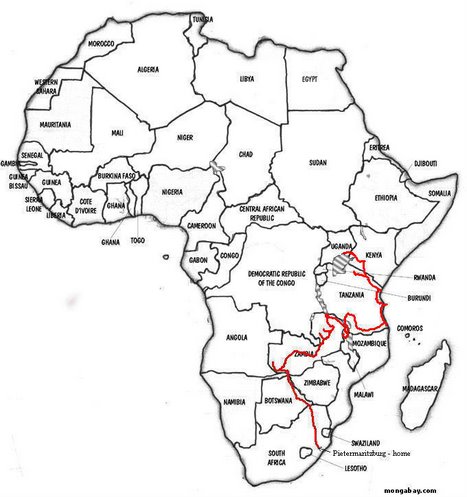
Our route
Tuesday, May 15, 2007

Tuesday, May 8, 2007
Mt Kilimanjaro
Monday 7th May 2007 Marangu Hotel Camp
Today we were woken by an excited Dave who had risen early to check the cloud cover over Mt Kili. It was clear so we put on the first clothes we could grab (Nev put on my jacket which was miles too small) and trotted out in the dewy-wet morning with our cameras to record the lucky event. At this time of the year with the rains and clouds we were very lucky to see the glistening white glacier at the summit of the 5895m high Uhuru mountain peak. The jaggered right hand 5149m high Mawenzi looked higher, but that was because it was closer.
We took a guide to show us the way to the extinct crater lake of Lake Chala. It is 3Km diameter and filled with turquoise crystal clear water. The surrounding 90 degrees forest-covered cliffs drop at into the bottomless fathoms. It is an amazing oasis which drops unexpectedly into the dry acacia and Euphorbia covered landscape where subsistence farmers eke out a living from the fertile, but dry Karroo-type soil.
The next part of our trip took us up the slopes of Mt Kili again through tropical forests of bananas with wild Busy-lizzies flowering on the damp moss covered roadsides. Our destination, a huge, stone, 106 year old Catholic church with beautiful stained-glass windows.
Then we went down the mountain to see the colourful Marangu market where we stocked up with six eggs at R1 each, two avocado pears at R1.50 each and four tomatoes for R1.50.
Our heavy-duty LHS back spring suddenly broke on the way, so we carefully drove around and after a drink at the local tavern with our friends, went off to Moshi to repair the damage. We had to fit two light-duty springs, as the nearest supply of heavy-duty ones was in Nairobi. The Landrover place replaced the brake-pads while they had all the wheels off Tsh250000 ($200) for the lot. The spring had a weak, corroded spot about 1/3 of the way through which had caused it to break.
Sunday 6th May 2007 Marangu Hotel Camp
While waiting for Dave to get his brakes fixed we went to the lovely Kinukamori waterfall and cultural display of sculptures depicting local folklore. It was very well done and, although not spectacular, well worth supporting the community who are running it. A trip to Moshi to see the country around Mt Kili revealed the stark difference between the cool, lush and fertile slopes of the mountain and the hot, dry acacia Karroo landscape on the flats surrounding it.
The group re-united having had problems with Brian’s Landy when the prop-shaft fell off!! No serious damage, but had to drive in2-wheel drive till he was able to fix it. They had an interesting but exhausting 5-hour walk in the steep, lush and spectacular Usambara mountains, taking in the spectacular but chilly scenery in the mountains and thrilling views across the plains.
Saturday 5th May 2007 Marangu Hotel camp
The long road to Marangu was uneventful except for Dave having another puncture. We listened to book tapes to relieve the boredom of hot dry acacia-filled flats, while avoiding the maniacal, crabbing, center-pin-less busses intent on suicide and wiping us out while doing it, whether approaching at break-neck speed or side-swiping us while overtaking. The many police road-blocks with police in crisp, snow-white uniforms were busy checking the passing busses and did not bother with us at all.
Friday 4th May 2007 Lily Pad Quarry camp
Morning saw us getting our Landy cleaned at a car-wash to get rid of the caked-on mud. Every time they sprayed my door I got a foot-wash because Landys aren’t very water-proof. Then we spent two hours getting across Dar to find the BP depot to get our gas cylinders refilled. It took us the whole afternoon because of the go-slow as Nev refused to bribe the man with the requested Tsh5000, (R30). Driving west at 5pm into the sun out of Dar was rather uncomfortable, and we made slow headway. On the road to Chalinze after dark we found a quarry with ponds of water-lilly pads and Dave, Beryl and we made camp there that night with the sound of traffic all night long. During the night I heard a “motar bomb” exploding and on our way out we found two trucks had collided head on, which explained the noise.
Our friends stayed at Dar to complete their repairs, intending to go to Lushoto in the Ushabara mountains before meeting us in Marangu.
We made our way to Tanga, a Tanzanian surprise! It is one of the few places we have seen which is prospering. There is a cement factory and huge sisal plantations which have started to bring money into Tanga. Instead of dhows in the harbour there was a yacht club with expensive ski boats and yachts anchored in the mangrove-surrounded bay. New homes and renovations were being done in the ‘elite’ peninsular. We stayed in the up-market Kiboko Hotel grounds where a fat little Swiss bod who had been there for 25years welcomed us with genial hospitality.
Thursday 3rd May 2007 Silver Sands
Hope the others can complete their repairs as we are looking forward to leaving Dar. Shopped and found an internet café and slept the night in the same place waiting for completion of vehicle repairs.
Today we were woken by an excited Dave who had risen early to check the cloud cover over Mt Kili. It was clear so we put on the first clothes we could grab (Nev put on my jacket which was miles too small) and trotted out in the dewy-wet morning with our cameras to record the lucky event. At this time of the year with the rains and clouds we were very lucky to see the glistening white glacier at the summit of the 5895m high Uhuru mountain peak. The jaggered right hand 5149m high Mawenzi looked higher, but that was because it was closer.
We took a guide to show us the way to the extinct crater lake of Lake Chala. It is 3Km diameter and filled with turquoise crystal clear water. The surrounding 90 degrees forest-covered cliffs drop at into the bottomless fathoms. It is an amazing oasis which drops unexpectedly into the dry acacia and Euphorbia covered landscape where subsistence farmers eke out a living from the fertile, but dry Karroo-type soil.
The next part of our trip took us up the slopes of Mt Kili again through tropical forests of bananas with wild Busy-lizzies flowering on the damp moss covered roadsides. Our destination, a huge, stone, 106 year old Catholic church with beautiful stained-glass windows.
Then we went down the mountain to see the colourful Marangu market where we stocked up with six eggs at R1 each, two avocado pears at R1.50 each and four tomatoes for R1.50.
Our heavy-duty LHS back spring suddenly broke on the way, so we carefully drove around and after a drink at the local tavern with our friends, went off to Moshi to repair the damage. We had to fit two light-duty springs, as the nearest supply of heavy-duty ones was in Nairobi. The Landrover place replaced the brake-pads while they had all the wheels off Tsh250000 ($200) for the lot. The spring had a weak, corroded spot about 1/3 of the way through which had caused it to break.
Sunday 6th May 2007 Marangu Hotel Camp
While waiting for Dave to get his brakes fixed we went to the lovely Kinukamori waterfall and cultural display of sculptures depicting local folklore. It was very well done and, although not spectacular, well worth supporting the community who are running it. A trip to Moshi to see the country around Mt Kili revealed the stark difference between the cool, lush and fertile slopes of the mountain and the hot, dry acacia Karroo landscape on the flats surrounding it.
The group re-united having had problems with Brian’s Landy when the prop-shaft fell off!! No serious damage, but had to drive in2-wheel drive till he was able to fix it. They had an interesting but exhausting 5-hour walk in the steep, lush and spectacular Usambara mountains, taking in the spectacular but chilly scenery in the mountains and thrilling views across the plains.
Saturday 5th May 2007 Marangu Hotel camp
The long road to Marangu was uneventful except for Dave having another puncture. We listened to book tapes to relieve the boredom of hot dry acacia-filled flats, while avoiding the maniacal, crabbing, center-pin-less busses intent on suicide and wiping us out while doing it, whether approaching at break-neck speed or side-swiping us while overtaking. The many police road-blocks with police in crisp, snow-white uniforms were busy checking the passing busses and did not bother with us at all.
Friday 4th May 2007 Lily Pad Quarry camp
Morning saw us getting our Landy cleaned at a car-wash to get rid of the caked-on mud. Every time they sprayed my door I got a foot-wash because Landys aren’t very water-proof. Then we spent two hours getting across Dar to find the BP depot to get our gas cylinders refilled. It took us the whole afternoon because of the go-slow as Nev refused to bribe the man with the requested Tsh5000, (R30). Driving west at 5pm into the sun out of Dar was rather uncomfortable, and we made slow headway. On the road to Chalinze after dark we found a quarry with ponds of water-lilly pads and Dave, Beryl and we made camp there that night with the sound of traffic all night long. During the night I heard a “motar bomb” exploding and on our way out we found two trucks had collided head on, which explained the noise.
Our friends stayed at Dar to complete their repairs, intending to go to Lushoto in the Ushabara mountains before meeting us in Marangu.
We made our way to Tanga, a Tanzanian surprise! It is one of the few places we have seen which is prospering. There is a cement factory and huge sisal plantations which have started to bring money into Tanga. Instead of dhows in the harbour there was a yacht club with expensive ski boats and yachts anchored in the mangrove-surrounded bay. New homes and renovations were being done in the ‘elite’ peninsular. We stayed in the up-market Kiboko Hotel grounds where a fat little Swiss bod who had been there for 25years welcomed us with genial hospitality.
Thursday 3rd May 2007 Silver Sands
Hope the others can complete their repairs as we are looking forward to leaving Dar. Shopped and found an internet café and slept the night in the same place waiting for completion of vehicle repairs.
Thursday, May 3, 2007
070503 Dar es Salaam
Wednesday 2nd May Silver Sands
We all spent an interesting and frustrating day battling the traffic (it took us 2 hours to get into Dar to the Landrover gararge). Our problem was loose bolts in the suspension and had to do a service. Willy had brake, suspension and tyre problems. Brian had brake master cylinder problems. Dave’s Landcruiser had no brake linings left and is still having overheating problems caused by wiring faults. The soup we had travelled through, and overuse had caused the brake problems. Hehehe, our brakes were fine because of Nev’s method of driving using the correct gear rather than brakes, like one would drive a 10tonne truck. Hope this method carries on working. Willy has gone through two sets of brake linings already and messed up his drums.
We have torrential rains several times a day with the sun shining hotly between the squalls. The drainage system in the city cannot handle all the water and the streets and pavements are continually being flooded. Everyone arrived back in camp in foul moods, Nev muttering “Give me mud and potholes rather than this traffic” as it took us 2 hours to travel the 15Km. It was with relief that we found that there were no exceptions to this, and we could all laugh about our experiences.
The drivers here are different to in SA. If you want to enter the traffic from a side road you put up your hand and just go. The other cars, patiently give way. It is not odd to drive up the pavement, and if you are really in a hurry you put your flashing lights on and drive on the opposite side of the road with no problem.
Pedestrians and bicycles are everywhere. Walking is faster in most places than cars.
There are stalls on the side of the road selling roasted mealies, boiled eggs and pealed oranges. Fast food Tanzanian style! For the health conscious, other fresh fruit: mangoes, pawpaws and bananas. There are very few overweight people in Tanzania and most are lean and healthy looking. They walk briskly despite the heat, if they aren’t sitting around. We passed a group of young men milling around looking like they were going to pick up litter. The got into a line, crouched down and suddenly took off, racing each other at a sprint. We don’t know what happened after that as we were going in the opposite direction, but it was really funny to see.
Although the vehicles have been imported from SA, vehicles are 25% are cheaper here than in SA. Spares are cheaper, and labour charges are half the SA price. Cell calls are almost free. South Africans are being ripped off!!!
Tuesday 1st May 2007, Silver Sands Camp, Dar es Salaam
We walked to a community conservation turtle sanctuary. Very poor. The lighthouse on the tip was not allowed to be photographed for an unknown reason. We went for another quick and painful ride around the lodges on the northern coast and decided that our camp had the best beach. We headed back to the harbour to catch the ferry. This one was smaller and the sea was really rough. The ferry was leaping like a horse through water, and corkscrewing over the swells. The passengers were getting seasick, including Dave and Maureen, but we were fine. I thought the movement was great fun and sat up riding the waves like I would a horse.
We found our vehicles and headed for the campsite Siver Sands on the northern shore of Dar. It was nice to be back in our little ‘home’, although Zanzibar is wonderful.
Monday 30th April 2007 Zanzibar
Next day we went for a snorkel off the shore. I was just about to comment that every focus was a “wow!” moment when I started to feel uncomfortable pricking sensations on my arms and legs. We were being stung by some jelly fish things which looked like a string of actively swimming frogs’ eggs. No lasting damage, but we left that area to snorkel elsewhere. Visibility in the water was close to 20m, unbelievably clear. The sands on the beaches are pure white (originating from limestone), brochure book examples with dhows and mocorros making a beautiful picture.
We hired a motor bike and toured the north eastern shores and interior of the island. All the cattle are tethered to the sides of the road while most of the land is cropped with rice, cocoanuts (tall for oil and cooking, short dwarf ones for the milk), bananas, spices (which we didn’t see), a rubber industry and many other things. The baobabs were very short as there was stone all over the island and they cant get their roots down. On the lower east coast they were clearing the bush and planting trees which they cut for building their houses. Most of the houses were mud and limestone with palm-leaf thatched roofs. They were cutting out and destroying hundreds of 3m high cycads which made us cry as they must have been hundreds of years old. It rains here several times a day, hard for about 15 minutes, then the sun comes out. So we got soaked through and then blow-dried in minutes. The rain doesn’t phase the locals who just carry on with their lives unperturbed. By the time we were half way back our backsides were numb and raw from the uncomfortable seat.
Back on the beach we saw a snaking water spout over the sea that lasted for 10 minutes, about at least 1Km high into the swirling black clouds. We could see how it was sucking the water out of the sea. Someone must have had salty rain somewhere when it eventually came down.
Sunday 29th April 2007 Zanzibar
Our group separated for the morning and we explored Stone Town at our own pace. Stone Town is a living village inhabited by people going about their everyday business, not a town especially for tourists. A guide found us and took us on a tour of the Town, explaining the history of the buildings and the local culture. We were taken into a Hindu Temple where a young scholar explained the gods to us, the museum, Portuguese fort from 16th century, the last slave market, Sultans mansion from 14th century. The Arabic doors were made of solid wood with huge brass knobs and intricate carvings. The more elaborate the door, the higher the status of the owner. The brass knobs were a fashion originally from the Arabian method of protecting their houses against attack by war elephants. The best part for us was the market area. There were literally hundreds of tiny shops selling everything from spices and kangas, to hardware and shoes. In fact, everything except motor cars and electrical goods. We watched the daily catch being auctioned at the fish market. The chicken market had live chickens in baskets right there next to the plucked fowls displayed on the counters. All kinds of locally grown fruit and veges were displayed by their growers. We tasted the delicious Jack Fruit cut up with great dexterity by a man with a huge dagger. At the meat section you could choose your favourite cut from the quarters of cattle and goats lying on the concrete counters in front of you. There was an atmosphere of bustling organized chaos. Do you think Africa will ever change? Why would we want it to?
Just before lunch we all met up and were taken on a “Spice tour”. Lunch at the farm consisted of Pilau Rice (spiced rice) with two types of sauces, made from the locally grown ingredients and natural spices, and casava tips as a green vegetable. The yellow sauce (made with cocoanut milk) on the rice was voted the most delicious. We were then taken around the spice, herb and tree garden “African style” (no paths) with everything scattered and growing amongst the weeds. Our guide showed us and explained the uses of some forty different plants while the youngsters continually surprised us with gifts of baskets, hats, ties, rings and necklaces they were weaving for us out of palm leaves while we toured the 2Ha area.
We then proceeded to our hotel 40Km north of Zanzibar Town to the very northern tip of the island, Nungwe. This was also a 1-star hotel where we found someone fast asleep in our allocated bedroom. We responded angrily by telling them to change the sheets, curtains and paint the place out – joking, but they did change the sheets. The mozzie nets had holes so we added the net from the other bed to try to prevent being eaten, but we still had to do mozzie hunting a few times in the middle of the night, unfortunately leaving blood splattered marks around. It never ceases to amaze us that the showers are almost dircly over the toilets. The toilets get soaked and going to the toilets involve getting wet feet wherever you go. The are no walls around the shower to contain the water. It could be time saving as one could do two jobs in one.
Saturday 28th April 2007 Coco De Mer Zanzibar
We drove around the water inlet at Dar es Salaam rather than going over the ferry, and encountered the filth and slum area of Dar. Unbelievable stench from rotting human detritus! The traffic was so slow moving that the pedestrians were walking faster than the traffic was moving most of the time. We kept passing the same group of people, who kept passing us again. I covered my head with a scarf (Muslim style) as I started to feel like the men were gawking at me. At a roundabout all the traffic came to a complete standstill for 15 minutes while we wondered what had happened and eventually Nev walked up to see whether there was an accident. Just then a cavalcade of police escorting some dignitary whizzed past with sirens blaring and lights flashing. We got to the harbour to arrange the ferry crossing and accommodation in Zanzibar. The touts mobbed us, all trying to earn their commission by getting customers to their travel and hotel accomodation agent. The books warn of unscrupulous dealers who overcharge or rip you off so we were very very suspicious and wary. I sat sweltering in the car while Nev and some others went to book. I was continually approached by people selling wares and they wouldn’t go away until I started to speak to them in Swahili and then they were greatly amused and very much more respectful and friendly and stopped trying to sell, instead chatted about BafanaBafana, 2010, and South Africa!
Meanwhile Nev and them were bargaining for hotel accommodation on Zanzibar, and sorted it out, not knowing really what we were in for. We then left to park the cars at Brian’s cousin’s firm’s place (previously arranged) and got lost. We had to load a local friendly bod who kindly took us there. We caught taxis back to the harbour and eventually left on the high-speed luxury” ferry Sea Bus III” at 4.30pm, one hour late. The crossing was uneventful except Maureen got seasick. We arrived in Zanzibar in the dark wondering how we were going to get to the hotel.
We were amazed and surprised when we were met at the harbour by a taximan who took us to the hotel, a 1-star Coco De Mer, clean sheets, hot shower, and aircon, situated down a dingy lane in Stone Town.
York in Britain, is nothing compared to Stone Town, with its wiggly maze of little lanes made by three story buildings of a mixture of Arabic, English and German architecture. Some of the Lanes are so narrow that it was difficult for 2 people to pass. We continually got lost and had to ask locals to guide us out, which they gladly did for a small fee. That night we went to the sea front where they have a highly atmospheric open air fish braai market with a variety of raw seafood displayed, lit by paraffin lamps. Everything from the display of the food, to the cooking methods to the eating, paying, and garbage disposal would have been condemned by the hygiene standards in any first world country, but it all contributed to a wonderfully ethnic, vibrant and exciting atmosphere with delicious selection of locally caught seafood. Crab, prawns, crayfish, calamari, octopus, squid and sea fish were on offer at ridiculously low prices. The choice was grilled on open fires. We loved the sugar cane juice which was produced by crushing the cane through two rollers by a sweaty man turning a handle while the other fed the cane stalks through the mangle. The juice dripped into a bucket of ice and was scooped up with a cup, sieved and served in a glass with a squeeze of lemon – deliciously refreshing. Zanzibar pizzas were another hit with us, made with great alacrity and speed by another few men working as a team frying the savoury pastry tartlets which they couldn’t make fast enough. Handling the grubby money, kneading the dough and spreading the ingredients with the same hand, but they were delicious. It was all a bit of a whirlwind, almost like being at a fairground, but better. The next day to our surprise none of us were the worse for ware.
Friday 27th April 2007 Kim Beach Camp
We left early (after being fed by Patrick and his crew) for Dar Es Salaam. Three of our crew had runny tummies from the food cooked at the camp from the night before, but no lasting problems. The road started off as a nice tar road and guess what? It deteriorated into a single track of humpy wet muddy slosh. We couldn’t see how deep the holes were, as they were full of water, and the traffic had churned the sand up into soupy mud. Luckily there was a low clay content so it was relatively hard beneath the slosh. One cannot believe that it is the main (and only) road south from Dar. We drove along this unbelievable road for 5 hours averaging less than 20Km/hr. It was with great difficulty that we had to squeeze pass heavily laden trucks busses and taxis all traveling south. The taxis were so loaded that the passengers were standing up squashed together in ‘spoon’ positions, some hanging out the open door holding on with one hand, others had their bottoms sticking out the windows. Some places had thick bush on either side consisting of diverse trees such as mahogany, acacia, palms, mangoes and cashew nut trees. And then suddenly it turned into a beautiful 1st world tarred road again. We did the 300Km trip in 7 hours and found another camp site right on a white sandy beach with the ubiquitous lapping waves again! At least there is a nice lot of clean water this time brought to us in buckets by the camp managers. We had showers outside our Landy but had to ask the guard to move so we could have some privacy. I am learning to say a few words of Kiswahili which is coming in very handy. The palm trees are right to the water’s edge and our Landy is parked 10m from the water. The locals just don’t realize they live in paradise. Farming consists of millions of coconut palms all the way with cassava, maize, sweet potatoes and citrus, bananas and pawpaws half a meter long and delicious. One pawpaw cost us R2.50, and the bananas cost 15c each. We passed through one of the villages where they were making furniture out of beautiful mahogany. We wished we had a furniture van to take it home. The forests are of course being deforested by this, as well as the charcoal makers.
There are numerous police road blocks in Tanzania, but most just wave us through. So far we have had no trouble at all.
Thursday 26th April 2007 Kilwa Dreams camp site.
We arrived at Kilwa quite early and wanted to visit Kilwa Kisiwani Island and found out it was a public holiday so everything was closed. Our Camp manager, Patrick, went out of his way to make sure we were happy. He went to find the officer at his house, who had to put on his uniform and get to the office to issue a permit. Then he had to organize a dhow to take us across to the island. We were about to leave at around noon when it started to rain and everyone wanted to cancel and go tomorrow. Nev insisted that we wait for 30 minutes before making a decision because we have found that the rain, although it does come down hard, does not last long, and then the sun comes out again. Like squalls come over and then go. After 20 minutes the rain cleared and we boarded the dhow and crossed the 2Km in 30 minutes. It was slow, quite and peaceful under the large, patched triangular sail. We sat on the ballast of sand bags with the wet sails dripping slowly onto us.
Kilwa Kisiwani is a 20SqKm island 2Km off the mainland which was occupied by a series of Arab Sultans from the 13th to the 15th century. Then the Portuguese bombarded Kilwa and moved the headquarters of the gold and slave trades to Mombassa. Kilwa was the main gold trading centre with the gold mined as far afield as Zimbabwe. The Sultans became extremely rich and built extravagant mosques and houses for themselves out of the coral which they mined right there off the shore. All is now in ruins, and it reminded us of walking around all the Roman ruins in Britain, (Hadrian’s Wall and the various cathedrals). There are about 1600 mainly Muslim people who live there by fishing and a bit of agriculture. The Portuguese took over the Island in 1512, but most died of malaria and they abandoned it. We had great fun clambering about the ruins, so much so that we got left behind by the rest of the group and got lost!! We walked around for about 30 minutes before luckily meeting up with them again.
After arriving back at the camp we had a lazy late afternoon. The tide was out and we had to swim in 1/2m deep water or else walk for 500m to get to deeper water. We still cannot get used to there being no waves in the sea. The waves in the Lakes Tanganyka and Malawe were bigger than these. We are longing for some great big strong waves to crash onto the beach instead of these weak things that lap the shore.
Wednesday 25th April 2007 Quarry Camp
The Lodge we stayed at was called Rovula Safari Lodge, which we left and proceeded north towards Kilwa on some disgusting roads. (Note the adjectives have changed from bumpy and wet to disgusting, depending on our mood). The Chinese are at present tarring this 400Km section but they are doing the whole sections at once instead of starting from one end so in places we were going half a meter deep in muddy slosh. The Chinese are having an uphill battle trying to cope with the rain while hardening their new road. It is also obvious that there are no environmentalists around as they are bulldozing huge baobabs down in sections. Also in their quarried, they clear and push the logs into the streams and don’t concentrate on one area, but have 5Ha quarries, abandon them and move onto the next one.
We slept in one of these quarries in one of the few sparsely populated areas so far in Tanzania.
We all spent an interesting and frustrating day battling the traffic (it took us 2 hours to get into Dar to the Landrover gararge). Our problem was loose bolts in the suspension and had to do a service. Willy had brake, suspension and tyre problems. Brian had brake master cylinder problems. Dave’s Landcruiser had no brake linings left and is still having overheating problems caused by wiring faults. The soup we had travelled through, and overuse had caused the brake problems. Hehehe, our brakes were fine because of Nev’s method of driving using the correct gear rather than brakes, like one would drive a 10tonne truck. Hope this method carries on working. Willy has gone through two sets of brake linings already and messed up his drums.
We have torrential rains several times a day with the sun shining hotly between the squalls. The drainage system in the city cannot handle all the water and the streets and pavements are continually being flooded. Everyone arrived back in camp in foul moods, Nev muttering “Give me mud and potholes rather than this traffic” as it took us 2 hours to travel the 15Km. It was with relief that we found that there were no exceptions to this, and we could all laugh about our experiences.
The drivers here are different to in SA. If you want to enter the traffic from a side road you put up your hand and just go. The other cars, patiently give way. It is not odd to drive up the pavement, and if you are really in a hurry you put your flashing lights on and drive on the opposite side of the road with no problem.
Pedestrians and bicycles are everywhere. Walking is faster in most places than cars.
There are stalls on the side of the road selling roasted mealies, boiled eggs and pealed oranges. Fast food Tanzanian style! For the health conscious, other fresh fruit: mangoes, pawpaws and bananas. There are very few overweight people in Tanzania and most are lean and healthy looking. They walk briskly despite the heat, if they aren’t sitting around. We passed a group of young men milling around looking like they were going to pick up litter. The got into a line, crouched down and suddenly took off, racing each other at a sprint. We don’t know what happened after that as we were going in the opposite direction, but it was really funny to see.
Although the vehicles have been imported from SA, vehicles are 25% are cheaper here than in SA. Spares are cheaper, and labour charges are half the SA price. Cell calls are almost free. South Africans are being ripped off!!!
Tuesday 1st May 2007, Silver Sands Camp, Dar es Salaam
We walked to a community conservation turtle sanctuary. Very poor. The lighthouse on the tip was not allowed to be photographed for an unknown reason. We went for another quick and painful ride around the lodges on the northern coast and decided that our camp had the best beach. We headed back to the harbour to catch the ferry. This one was smaller and the sea was really rough. The ferry was leaping like a horse through water, and corkscrewing over the swells. The passengers were getting seasick, including Dave and Maureen, but we were fine. I thought the movement was great fun and sat up riding the waves like I would a horse.
We found our vehicles and headed for the campsite Siver Sands on the northern shore of Dar. It was nice to be back in our little ‘home’, although Zanzibar is wonderful.
Monday 30th April 2007 Zanzibar
Next day we went for a snorkel off the shore. I was just about to comment that every focus was a “wow!” moment when I started to feel uncomfortable pricking sensations on my arms and legs. We were being stung by some jelly fish things which looked like a string of actively swimming frogs’ eggs. No lasting damage, but we left that area to snorkel elsewhere. Visibility in the water was close to 20m, unbelievably clear. The sands on the beaches are pure white (originating from limestone), brochure book examples with dhows and mocorros making a beautiful picture.
We hired a motor bike and toured the north eastern shores and interior of the island. All the cattle are tethered to the sides of the road while most of the land is cropped with rice, cocoanuts (tall for oil and cooking, short dwarf ones for the milk), bananas, spices (which we didn’t see), a rubber industry and many other things. The baobabs were very short as there was stone all over the island and they cant get their roots down. On the lower east coast they were clearing the bush and planting trees which they cut for building their houses. Most of the houses were mud and limestone with palm-leaf thatched roofs. They were cutting out and destroying hundreds of 3m high cycads which made us cry as they must have been hundreds of years old. It rains here several times a day, hard for about 15 minutes, then the sun comes out. So we got soaked through and then blow-dried in minutes. The rain doesn’t phase the locals who just carry on with their lives unperturbed. By the time we were half way back our backsides were numb and raw from the uncomfortable seat.
Back on the beach we saw a snaking water spout over the sea that lasted for 10 minutes, about at least 1Km high into the swirling black clouds. We could see how it was sucking the water out of the sea. Someone must have had salty rain somewhere when it eventually came down.
Sunday 29th April 2007 Zanzibar
Our group separated for the morning and we explored Stone Town at our own pace. Stone Town is a living village inhabited by people going about their everyday business, not a town especially for tourists. A guide found us and took us on a tour of the Town, explaining the history of the buildings and the local culture. We were taken into a Hindu Temple where a young scholar explained the gods to us, the museum, Portuguese fort from 16th century, the last slave market, Sultans mansion from 14th century. The Arabic doors were made of solid wood with huge brass knobs and intricate carvings. The more elaborate the door, the higher the status of the owner. The brass knobs were a fashion originally from the Arabian method of protecting their houses against attack by war elephants. The best part for us was the market area. There were literally hundreds of tiny shops selling everything from spices and kangas, to hardware and shoes. In fact, everything except motor cars and electrical goods. We watched the daily catch being auctioned at the fish market. The chicken market had live chickens in baskets right there next to the plucked fowls displayed on the counters. All kinds of locally grown fruit and veges were displayed by their growers. We tasted the delicious Jack Fruit cut up with great dexterity by a man with a huge dagger. At the meat section you could choose your favourite cut from the quarters of cattle and goats lying on the concrete counters in front of you. There was an atmosphere of bustling organized chaos. Do you think Africa will ever change? Why would we want it to?
Just before lunch we all met up and were taken on a “Spice tour”. Lunch at the farm consisted of Pilau Rice (spiced rice) with two types of sauces, made from the locally grown ingredients and natural spices, and casava tips as a green vegetable. The yellow sauce (made with cocoanut milk) on the rice was voted the most delicious. We were then taken around the spice, herb and tree garden “African style” (no paths) with everything scattered and growing amongst the weeds. Our guide showed us and explained the uses of some forty different plants while the youngsters continually surprised us with gifts of baskets, hats, ties, rings and necklaces they were weaving for us out of palm leaves while we toured the 2Ha area.
We then proceeded to our hotel 40Km north of Zanzibar Town to the very northern tip of the island, Nungwe. This was also a 1-star hotel where we found someone fast asleep in our allocated bedroom. We responded angrily by telling them to change the sheets, curtains and paint the place out – joking, but they did change the sheets. The mozzie nets had holes so we added the net from the other bed to try to prevent being eaten, but we still had to do mozzie hunting a few times in the middle of the night, unfortunately leaving blood splattered marks around. It never ceases to amaze us that the showers are almost dircly over the toilets. The toilets get soaked and going to the toilets involve getting wet feet wherever you go. The are no walls around the shower to contain the water. It could be time saving as one could do two jobs in one.
Saturday 28th April 2007 Coco De Mer Zanzibar
We drove around the water inlet at Dar es Salaam rather than going over the ferry, and encountered the filth and slum area of Dar. Unbelievable stench from rotting human detritus! The traffic was so slow moving that the pedestrians were walking faster than the traffic was moving most of the time. We kept passing the same group of people, who kept passing us again. I covered my head with a scarf (Muslim style) as I started to feel like the men were gawking at me. At a roundabout all the traffic came to a complete standstill for 15 minutes while we wondered what had happened and eventually Nev walked up to see whether there was an accident. Just then a cavalcade of police escorting some dignitary whizzed past with sirens blaring and lights flashing. We got to the harbour to arrange the ferry crossing and accommodation in Zanzibar. The touts mobbed us, all trying to earn their commission by getting customers to their travel and hotel accomodation agent. The books warn of unscrupulous dealers who overcharge or rip you off so we were very very suspicious and wary. I sat sweltering in the car while Nev and some others went to book. I was continually approached by people selling wares and they wouldn’t go away until I started to speak to them in Swahili and then they were greatly amused and very much more respectful and friendly and stopped trying to sell, instead chatted about BafanaBafana, 2010, and South Africa!
Meanwhile Nev and them were bargaining for hotel accommodation on Zanzibar, and sorted it out, not knowing really what we were in for. We then left to park the cars at Brian’s cousin’s firm’s place (previously arranged) and got lost. We had to load a local friendly bod who kindly took us there. We caught taxis back to the harbour and eventually left on the high-speed luxury” ferry Sea Bus III” at 4.30pm, one hour late. The crossing was uneventful except Maureen got seasick. We arrived in Zanzibar in the dark wondering how we were going to get to the hotel.
We were amazed and surprised when we were met at the harbour by a taximan who took us to the hotel, a 1-star Coco De Mer, clean sheets, hot shower, and aircon, situated down a dingy lane in Stone Town.
York in Britain, is nothing compared to Stone Town, with its wiggly maze of little lanes made by three story buildings of a mixture of Arabic, English and German architecture. Some of the Lanes are so narrow that it was difficult for 2 people to pass. We continually got lost and had to ask locals to guide us out, which they gladly did for a small fee. That night we went to the sea front where they have a highly atmospheric open air fish braai market with a variety of raw seafood displayed, lit by paraffin lamps. Everything from the display of the food, to the cooking methods to the eating, paying, and garbage disposal would have been condemned by the hygiene standards in any first world country, but it all contributed to a wonderfully ethnic, vibrant and exciting atmosphere with delicious selection of locally caught seafood. Crab, prawns, crayfish, calamari, octopus, squid and sea fish were on offer at ridiculously low prices. The choice was grilled on open fires. We loved the sugar cane juice which was produced by crushing the cane through two rollers by a sweaty man turning a handle while the other fed the cane stalks through the mangle. The juice dripped into a bucket of ice and was scooped up with a cup, sieved and served in a glass with a squeeze of lemon – deliciously refreshing. Zanzibar pizzas were another hit with us, made with great alacrity and speed by another few men working as a team frying the savoury pastry tartlets which they couldn’t make fast enough. Handling the grubby money, kneading the dough and spreading the ingredients with the same hand, but they were delicious. It was all a bit of a whirlwind, almost like being at a fairground, but better. The next day to our surprise none of us were the worse for ware.
Friday 27th April 2007 Kim Beach Camp
We left early (after being fed by Patrick and his crew) for Dar Es Salaam. Three of our crew had runny tummies from the food cooked at the camp from the night before, but no lasting problems. The road started off as a nice tar road and guess what? It deteriorated into a single track of humpy wet muddy slosh. We couldn’t see how deep the holes were, as they were full of water, and the traffic had churned the sand up into soupy mud. Luckily there was a low clay content so it was relatively hard beneath the slosh. One cannot believe that it is the main (and only) road south from Dar. We drove along this unbelievable road for 5 hours averaging less than 20Km/hr. It was with great difficulty that we had to squeeze pass heavily laden trucks busses and taxis all traveling south. The taxis were so loaded that the passengers were standing up squashed together in ‘spoon’ positions, some hanging out the open door holding on with one hand, others had their bottoms sticking out the windows. Some places had thick bush on either side consisting of diverse trees such as mahogany, acacia, palms, mangoes and cashew nut trees. And then suddenly it turned into a beautiful 1st world tarred road again. We did the 300Km trip in 7 hours and found another camp site right on a white sandy beach with the ubiquitous lapping waves again! At least there is a nice lot of clean water this time brought to us in buckets by the camp managers. We had showers outside our Landy but had to ask the guard to move so we could have some privacy. I am learning to say a few words of Kiswahili which is coming in very handy. The palm trees are right to the water’s edge and our Landy is parked 10m from the water. The locals just don’t realize they live in paradise. Farming consists of millions of coconut palms all the way with cassava, maize, sweet potatoes and citrus, bananas and pawpaws half a meter long and delicious. One pawpaw cost us R2.50, and the bananas cost 15c each. We passed through one of the villages where they were making furniture out of beautiful mahogany. We wished we had a furniture van to take it home. The forests are of course being deforested by this, as well as the charcoal makers.
There are numerous police road blocks in Tanzania, but most just wave us through. So far we have had no trouble at all.
Thursday 26th April 2007 Kilwa Dreams camp site.
We arrived at Kilwa quite early and wanted to visit Kilwa Kisiwani Island and found out it was a public holiday so everything was closed. Our Camp manager, Patrick, went out of his way to make sure we were happy. He went to find the officer at his house, who had to put on his uniform and get to the office to issue a permit. Then he had to organize a dhow to take us across to the island. We were about to leave at around noon when it started to rain and everyone wanted to cancel and go tomorrow. Nev insisted that we wait for 30 minutes before making a decision because we have found that the rain, although it does come down hard, does not last long, and then the sun comes out again. Like squalls come over and then go. After 20 minutes the rain cleared and we boarded the dhow and crossed the 2Km in 30 minutes. It was slow, quite and peaceful under the large, patched triangular sail. We sat on the ballast of sand bags with the wet sails dripping slowly onto us.
Kilwa Kisiwani is a 20SqKm island 2Km off the mainland which was occupied by a series of Arab Sultans from the 13th to the 15th century. Then the Portuguese bombarded Kilwa and moved the headquarters of the gold and slave trades to Mombassa. Kilwa was the main gold trading centre with the gold mined as far afield as Zimbabwe. The Sultans became extremely rich and built extravagant mosques and houses for themselves out of the coral which they mined right there off the shore. All is now in ruins, and it reminded us of walking around all the Roman ruins in Britain, (Hadrian’s Wall and the various cathedrals). There are about 1600 mainly Muslim people who live there by fishing and a bit of agriculture. The Portuguese took over the Island in 1512, but most died of malaria and they abandoned it. We had great fun clambering about the ruins, so much so that we got left behind by the rest of the group and got lost!! We walked around for about 30 minutes before luckily meeting up with them again.
After arriving back at the camp we had a lazy late afternoon. The tide was out and we had to swim in 1/2m deep water or else walk for 500m to get to deeper water. We still cannot get used to there being no waves in the sea. The waves in the Lakes Tanganyka and Malawe were bigger than these. We are longing for some great big strong waves to crash onto the beach instead of these weak things that lap the shore.
Wednesday 25th April 2007 Quarry Camp
The Lodge we stayed at was called Rovula Safari Lodge, which we left and proceeded north towards Kilwa on some disgusting roads. (Note the adjectives have changed from bumpy and wet to disgusting, depending on our mood). The Chinese are at present tarring this 400Km section but they are doing the whole sections at once instead of starting from one end so in places we were going half a meter deep in muddy slosh. The Chinese are having an uphill battle trying to cope with the rain while hardening their new road. It is also obvious that there are no environmentalists around as they are bulldozing huge baobabs down in sections. Also in their quarried, they clear and push the logs into the streams and don’t concentrate on one area, but have 5Ha quarries, abandon them and move onto the next one.
We slept in one of these quarries in one of the few sparsely populated areas so far in Tanzania.
Wednesday, April 25, 2007
Tanzania MSAMBITI LODGE 070423
It would be interesting to know how many (if any) are reading this blog. So if you are able, as soon as you have read it, please comment via SMS/text to +27824934842.
For another slant on the trip, log on to www.4x4africa.blogspot.com for Dave and Beryl’s site. They have some lovely photos. I haven’t got to doing photos yet, sorry.
Tuesday 24th April 2007 Msibathi Beach last night here
Willy and Brian went out early and caught three Jack Fish and one King fish. He gave us one of the Jacks, and I filleted it. It has armoured scales along its dorsal, sides and tail, and is a stream-lined fish built for speed with re-curved sickle-shaped pectoral fins. It is a fish with red muscles (not white flesh) and is tender and delicious when fried fast.
A man came around with a jar of evil-smelling ointment which he called “Ambari” wanting us to buy some. Well, it was either a huge con, or something very valuable which we couldn’t use anyway. We tried all ways to communicate but my phrase book was absolutely useless except to tell him that we didn’t understand and we didn’t want it anyway. Mareen’s hands have eventually started to heal from the mystery infection and we are all well rested and eager to see the rest of Africa.
Dad, we are sorry to hear you are not well, and hope you get better soon. All we ask is for you to stay healthy!!
Monday 23rd April 2007 Msibathi Beach still
We went for a snorkel. Better than a Sordwana dive. The reef was between 2m and 5m under the crystal clear water visability 10 to15m. The coral was not pristine, and smaller or younger than at Sordwana, but accessible from a snorkel. Diverse beautiful fish and coral right under us.
Otherwise we had a lazy day. Or rather Nev did, I skoffeled around rearranging stuff so now I don’t know where anything is!!
Sunday 22nd April 2007 Msimbathi Beach
To get to this idyllic beach, it took 2.5 hours with a few wrong turnings and many large bumps that everyone was starting to get irritated with because we had just been over some really bad roads in the last 4 days. Dave had another puncture, the eighth in the same 6ply wheel!! He stlll cannot find what is causing the puncture. The garage before, told him it was sand, but that was not the case this time. He has split rims, maybe that is the reason.
The locals are friendly, but only respond readliy to smiles and waves, but do not initiate greetings. They speak only Kiswahili and think I am very funny when I bring out the phrase book and try to say things like “greetings” or “see you later” or what is your name”. The name Lorraine is beyond their tongue and pronounce it Rorayn.
It can also be very frustrating talking to them or asking questions, eg if you ask them “Is this the road to Msimbathi?” they will readily say Yes, but if you say is that the road, pointing to the other fork, they will also say Yes. Like the TV advert about “Which way Douglas Green ?” and they point in all directions.
After arriving in this Marine Reserve we realized that it was worth all the travel. The beach is isolated from first world development with basic campsite. It has the typical warm, tropical long white sandy shore, and little waves lapping gently, “Bird Island” offshore to the WEST! (so we see the sun setting over the sea) and far-off breakers indicating the presence of the shallow coral reefs. Cocoanut palm groves grow just above the high tide line, which is within spitting distance of our Landy home. White-triangular sailed dhows pass frequently, as do the fishing macoros which quietly pole by. The tempo here is relaxed, slow, unhurried and unstressed. The westerners have it all wrong! These locals live in paradise. The temps are 34 during the day but only cools to 26 at night, so we don’t even unpack the sleeping bags, just need sheets.
The name Marine Reserve is not what it is in SA with strict controls, because as when we entered the camp we were greeting by a pack of six dogs, the locals fish everywhere with nets, lines, spear guns and even hook reef fish. (A magnificent 6Kg parrot fish was offered to us to buy, but we did by a 6Kg Rock Cod which was delicious). There are also 2 gas wells just on the shore nearby being developed by a Canadian firm to supply power to Mtwara at present. They are 2,4Km deep for a future power station at Mtwara to supply power to southern Tanzania.
Brian and Willy also went fishing, had great fun trying to catch fish with bass equipment, but only came back with fisherman’s stories.
For another slant on the trip, log on to www.4x4africa.blogspot.com for Dave and Beryl’s site. They have some lovely photos. I haven’t got to doing photos yet, sorry.
Tuesday 24th April 2007 Msibathi Beach last night here
Willy and Brian went out early and caught three Jack Fish and one King fish. He gave us one of the Jacks, and I filleted it. It has armoured scales along its dorsal, sides and tail, and is a stream-lined fish built for speed with re-curved sickle-shaped pectoral fins. It is a fish with red muscles (not white flesh) and is tender and delicious when fried fast.
A man came around with a jar of evil-smelling ointment which he called “Ambari” wanting us to buy some. Well, it was either a huge con, or something very valuable which we couldn’t use anyway. We tried all ways to communicate but my phrase book was absolutely useless except to tell him that we didn’t understand and we didn’t want it anyway. Mareen’s hands have eventually started to heal from the mystery infection and we are all well rested and eager to see the rest of Africa.
Dad, we are sorry to hear you are not well, and hope you get better soon. All we ask is for you to stay healthy!!
Monday 23rd April 2007 Msibathi Beach still
We went for a snorkel. Better than a Sordwana dive. The reef was between 2m and 5m under the crystal clear water visability 10 to15m. The coral was not pristine, and smaller or younger than at Sordwana, but accessible from a snorkel. Diverse beautiful fish and coral right under us.
Otherwise we had a lazy day. Or rather Nev did, I skoffeled around rearranging stuff so now I don’t know where anything is!!
Sunday 22nd April 2007 Msimbathi Beach
To get to this idyllic beach, it took 2.5 hours with a few wrong turnings and many large bumps that everyone was starting to get irritated with because we had just been over some really bad roads in the last 4 days. Dave had another puncture, the eighth in the same 6ply wheel!! He stlll cannot find what is causing the puncture. The garage before, told him it was sand, but that was not the case this time. He has split rims, maybe that is the reason.
The locals are friendly, but only respond readliy to smiles and waves, but do not initiate greetings. They speak only Kiswahili and think I am very funny when I bring out the phrase book and try to say things like “greetings” or “see you later” or what is your name”. The name Lorraine is beyond their tongue and pronounce it Rorayn.
It can also be very frustrating talking to them or asking questions, eg if you ask them “Is this the road to Msimbathi?” they will readily say Yes, but if you say is that the road, pointing to the other fork, they will also say Yes. Like the TV advert about “Which way Douglas Green ?” and they point in all directions.
After arriving in this Marine Reserve we realized that it was worth all the travel. The beach is isolated from first world development with basic campsite. It has the typical warm, tropical long white sandy shore, and little waves lapping gently, “Bird Island” offshore to the WEST! (so we see the sun setting over the sea) and far-off breakers indicating the presence of the shallow coral reefs. Cocoanut palm groves grow just above the high tide line, which is within spitting distance of our Landy home. White-triangular sailed dhows pass frequently, as do the fishing macoros which quietly pole by. The tempo here is relaxed, slow, unhurried and unstressed. The westerners have it all wrong! These locals live in paradise. The temps are 34 during the day but only cools to 26 at night, so we don’t even unpack the sleeping bags, just need sheets.
The name Marine Reserve is not what it is in SA with strict controls, because as when we entered the camp we were greeting by a pack of six dogs, the locals fish everywhere with nets, lines, spear guns and even hook reef fish. (A magnificent 6Kg parrot fish was offered to us to buy, but we did by a 6Kg Rock Cod which was delicious). There are also 2 gas wells just on the shore nearby being developed by a Canadian firm to supply power to Mtwara at present. They are 2,4Km deep for a future power station at Mtwara to supply power to southern Tanzania.
Brian and Willy also went fishing, had great fun trying to catch fish with bass equipment, but only came back with fisherman’s stories.
Sunday, April 22, 2007
070421 Mtwari
Saturday 21st April 2007 TenDegreesSouth
We realized that most of the trees around the villages were huge old cashew nut trees which were not in flower at this time of the year, but produce around December. There were hundreds of kilometers of cashew nuts planted in rows that at one time must have been very organized, and the locals must still be getting a significant income from the trees.
In some parts the trees are very well tended and have been hoed underneath The trees look indigenous and the locals have not allowed the indigenous bushes to grow back and smother them. The man villages we passed through look very poor and the locals seem to eke out a living with maize, cassava, bananas, cashews and citrus.
We saw some scrawny cattle which look small Nguni type with not much colour which do not look like they are thriving.
We wasted some time and distance today because Brian decided he wanted to spend two days in Lindi, then go south and spend two days in Mtwara. Lindi was a busy town, but very African, and there was really nowhere that we were prepared to stay the night. It gave the impression of being dirty and we would rather have spent a night in another bush camp. The girls are starting to get agitated with not being able to wash clothes because we have spent so many nights in the bush, so are needing to find a place to wash and dry laundry. So my Bradt book came in handy and we went south to Makindani to a backpacker lodge run by and English chap called Martin. Very basic but clean and good grub.
Friday 20th April 2007 Bush camp – Cashew nut trees
Not much to report today- another day, same old potholed bumpy road, grinding our way along this appalling boring road. Then Nev said I should drive for a bit. None of the other girls have tried. So he tutored me and told me to ‘ride the contours’ to avoid hitting the holes head on. Afterwards he told me that he thought he had done very well. I couldn’t believe my ears!! I thought he got it wrong, but then clarified his statement by saying he hadn’t lost his temper or got irritated once! I thought I did quite well, anyway.
We came across what looked like an abandoned cashew nut factory and wondered where the cashew nuts were grown.
Thursday 19th April 2007 Bush camp at Road Works
We stopped at an hotel to ask how the road was between Songea and Lindi. It is very difficult to assess the information as a good road for us is not necessarily a ‘good’ road for them. The hotel manager said it was good for 4x4 but bad for 2x4. This confused us because that meant it was a bad road, we thought, but we weren’t going to turn back anyhow. After a cold drink we proceeded through Songea. The road turned out as we expected, some parts good, some parts really bad. Then we all screeched to a halt at the bridge. There in front of us was a 12 tonne truck (probably loaded with 20 tonnes) lying on its side in the shallow river on top of the collapsed bridge. This truck had passed us when we stopped to buy tomatoes and broke the bridge not 5 minutes before we got there. We couldn’t believe that a bridge which had stood for some 60 years would fall down 5 minutes before we arrived. No-one was hurt, but we think that the truck will lie there until they build another bridge over it because there are no evident recovery vehicles in the vicinity. The thought of going round to Lindi via Dar Es Salaam was horrifying, but luckily a local arrived in a Landcruiser who told us to follow him because he knew an alternative route, and he took off like Sarel van der Merwe doing a rally course with us in hot pursuit. A police vehicle loaded with a fully armed army patrol unit, machine guns slung across their chests was headed for the bridge too. When Nev told them the bridge was down, they didn’t go and investigate, but they said they would follow us as well. We had to move fast over a rutted potholed track between the houses of small villages with goats, chickens and children scattering out the way. The villages stood with their mouths agape as five 4x4s sped past with a police car and armed men chasing. It would have made a good movie as our guide knew of only one speed with his accelerator stuck flat down!!!! After a while he lost us, but we found the way by following his tracks. We proceeded along the road until we found a bush camp to spend the night. Nice weather, mild night, open air shower, no mozzies. Who said Africa is not fun?
We have settled into a very good routine. Each couple caters and cooks for themselves. We sometimes use each other’s hot water and showers. We find a camp at about 4pm, set up camp, cook, clean up, talk or play cards nd then read in bed till we fall asleep. We have a meeting each night to discuss what we intend to do the next day. Dave wakes us each morning and we have coffee and rusks and leave on the next day’s adventures. We all get along very well and there is a lots of teasing and bantering back and forth over the radios during the day. We take it in turns to lead the convoy each day, and it is all working very well. We are all happy campers so far. Except for poor Maureen who has some strange painfull infection or something on her hands which is making her trip miserable because she is in continual pain. She managed to get some pills at Livingstonia hospital, and we hope they work soon.
Wednesday 18th April 2007 Quarry camp
We left the mission early before the students arrived. Tanzanian time is one hour earlier than SA time. We proceeded to Mbeya to get brake pads for Will’s Landrover, a brake cylinder kit for Brian's, and Dave had to get punctures fixed. We had to get money and download blog.
Mbeya is a sprawling third word city with modern parts and shanty town with African markets. Everyone was very helpful and friendly.
We then proceeded west to Makambaku then south towards Songea and was amazed at how the country changed every 100 Km from the tropics at the border to like the Northern Transvaal to Estcourt to the Midlands type of countryside. In the midlands there were huge commercial tea plantations of thousands of Hectares, all neat and efficiently run, seemingly rotated with maize. Very impressive and the countryside is like Greytown and is 1800m above sea level. There were also large wattle and gum plantations and a wattle tannin extracting plant and saw mill, all commercially run. The country gradually changed to subsistence farming and the same type of Miombo woodland as in Zambia. The people here are far poorer than when we first came over the border. In Nyerere’s time, he forced the people to congregate and live in villages and collective farms, which is still very evident, but the collective farms have been divided into small individual plots. The road west is very good with very few potholes. One difference between Malawe, Zambia and Tanzania is that there very few of the road verges have been cut.
After a Bridge game in which Nev didn’t get to play once, he went to bed grumpy. We slept in a quarry and it rained all night, letting up for a short time in the morning for us to jump out of bed and pack up.
Tuesday 17th April 2007
After the 3x3 museum yesterday it was recommended that we go to a wonderful waterfall on the South Rumphi River and find Geoffry who would be our guide. After 6Km of dirt and breathtaking views of the Lake down below we found Geoffry who said walk would be 20 minutes and steep, but not too steep. After 30 minutes of slipping and sliding in moss down quite a steep slope we started to protest, but were encouraged and reassured that we were nearly there. After another 30 minutes now climbing down the rocky steep slope we could hear the waterfall and were again reassured that it was really close. After another 60 minutes of sweating even going downhill, in 34 degree heat, our thighs groaning and getting “jelly-legged” we reached a shear precipice and were told it was “just around the corner” which we believed this time. Nev followed the guide for another 200m straight down hanging by finger tips onto trees expecting the others to follow and arrived at the bottom to find a 10m high massive waterfall. There were huge trees on the opposite side of the gorge, with spray billowing up like a mini Victoria Falls. He waited for the others who never arrived, and after about 20 minutes realized that they had abandoned him. It was then alarm stations thinking he had to climb the vertical drop of 500m on his own with the guides, but soon caught up to Beryl who was suffering from dehydration and accompanied her slowly all the way to the top. It was a very welcome excuse to go slowly. The whole excursion took us 3.5hours with much mumbling and grumbling and whinging about African time, but everyone needed exercise. We found the first campsite on the shoreline and jumped into the lake without even booking into the site. Phil at the Vipya campsite was amazed!
Today, Tuesday, we proceeded to the border via Karonga and refueled and bought provisions. The border was without incident but slow. The fees were $50 each for a visa and $25 for ‘toll’ for the car. It was really late and we found a mission station to sleep. It rained and rained, and there was mud!
After crossing the border, we were amazed to see the change of vegetation compared to Malawe. It was suddenly very tropical, fertile, wet and hilly like the South Coast of Natal. The banana trees were at least 8m high and the bananas were huge and planted everywhere and there were huge bunches being sold on the sides of the roads. Under the bananas were coffee plants and madumbes. There were also Maize, mangoes potatoes and rice in the valleys and tea.
The Malawians seem much poorer than the Tanzanians. Southern Tanzania has the highest rainfall of up to 3000ml per annum.
We realized that most of the trees around the villages were huge old cashew nut trees which were not in flower at this time of the year, but produce around December. There were hundreds of kilometers of cashew nuts planted in rows that at one time must have been very organized, and the locals must still be getting a significant income from the trees.
In some parts the trees are very well tended and have been hoed underneath The trees look indigenous and the locals have not allowed the indigenous bushes to grow back and smother them. The man villages we passed through look very poor and the locals seem to eke out a living with maize, cassava, bananas, cashews and citrus.
We saw some scrawny cattle which look small Nguni type with not much colour which do not look like they are thriving.
We wasted some time and distance today because Brian decided he wanted to spend two days in Lindi, then go south and spend two days in Mtwara. Lindi was a busy town, but very African, and there was really nowhere that we were prepared to stay the night. It gave the impression of being dirty and we would rather have spent a night in another bush camp. The girls are starting to get agitated with not being able to wash clothes because we have spent so many nights in the bush, so are needing to find a place to wash and dry laundry. So my Bradt book came in handy and we went south to Makindani to a backpacker lodge run by and English chap called Martin. Very basic but clean and good grub.
Friday 20th April 2007 Bush camp – Cashew nut trees
Not much to report today- another day, same old potholed bumpy road, grinding our way along this appalling boring road. Then Nev said I should drive for a bit. None of the other girls have tried. So he tutored me and told me to ‘ride the contours’ to avoid hitting the holes head on. Afterwards he told me that he thought he had done very well. I couldn’t believe my ears!! I thought he got it wrong, but then clarified his statement by saying he hadn’t lost his temper or got irritated once! I thought I did quite well, anyway.
We came across what looked like an abandoned cashew nut factory and wondered where the cashew nuts were grown.
Thursday 19th April 2007 Bush camp at Road Works
We stopped at an hotel to ask how the road was between Songea and Lindi. It is very difficult to assess the information as a good road for us is not necessarily a ‘good’ road for them. The hotel manager said it was good for 4x4 but bad for 2x4. This confused us because that meant it was a bad road, we thought, but we weren’t going to turn back anyhow. After a cold drink we proceeded through Songea. The road turned out as we expected, some parts good, some parts really bad. Then we all screeched to a halt at the bridge. There in front of us was a 12 tonne truck (probably loaded with 20 tonnes) lying on its side in the shallow river on top of the collapsed bridge. This truck had passed us when we stopped to buy tomatoes and broke the bridge not 5 minutes before we got there. We couldn’t believe that a bridge which had stood for some 60 years would fall down 5 minutes before we arrived. No-one was hurt, but we think that the truck will lie there until they build another bridge over it because there are no evident recovery vehicles in the vicinity. The thought of going round to Lindi via Dar Es Salaam was horrifying, but luckily a local arrived in a Landcruiser who told us to follow him because he knew an alternative route, and he took off like Sarel van der Merwe doing a rally course with us in hot pursuit. A police vehicle loaded with a fully armed army patrol unit, machine guns slung across their chests was headed for the bridge too. When Nev told them the bridge was down, they didn’t go and investigate, but they said they would follow us as well. We had to move fast over a rutted potholed track between the houses of small villages with goats, chickens and children scattering out the way. The villages stood with their mouths agape as five 4x4s sped past with a police car and armed men chasing. It would have made a good movie as our guide knew of only one speed with his accelerator stuck flat down!!!! After a while he lost us, but we found the way by following his tracks. We proceeded along the road until we found a bush camp to spend the night. Nice weather, mild night, open air shower, no mozzies. Who said Africa is not fun?
We have settled into a very good routine. Each couple caters and cooks for themselves. We sometimes use each other’s hot water and showers. We find a camp at about 4pm, set up camp, cook, clean up, talk or play cards nd then read in bed till we fall asleep. We have a meeting each night to discuss what we intend to do the next day. Dave wakes us each morning and we have coffee and rusks and leave on the next day’s adventures. We all get along very well and there is a lots of teasing and bantering back and forth over the radios during the day. We take it in turns to lead the convoy each day, and it is all working very well. We are all happy campers so far. Except for poor Maureen who has some strange painfull infection or something on her hands which is making her trip miserable because she is in continual pain. She managed to get some pills at Livingstonia hospital, and we hope they work soon.
Wednesday 18th April 2007 Quarry camp
We left the mission early before the students arrived. Tanzanian time is one hour earlier than SA time. We proceeded to Mbeya to get brake pads for Will’s Landrover, a brake cylinder kit for Brian's, and Dave had to get punctures fixed. We had to get money and download blog.
Mbeya is a sprawling third word city with modern parts and shanty town with African markets. Everyone was very helpful and friendly.
We then proceeded west to Makambaku then south towards Songea and was amazed at how the country changed every 100 Km from the tropics at the border to like the Northern Transvaal to Estcourt to the Midlands type of countryside. In the midlands there were huge commercial tea plantations of thousands of Hectares, all neat and efficiently run, seemingly rotated with maize. Very impressive and the countryside is like Greytown and is 1800m above sea level. There were also large wattle and gum plantations and a wattle tannin extracting plant and saw mill, all commercially run. The country gradually changed to subsistence farming and the same type of Miombo woodland as in Zambia. The people here are far poorer than when we first came over the border. In Nyerere’s time, he forced the people to congregate and live in villages and collective farms, which is still very evident, but the collective farms have been divided into small individual plots. The road west is very good with very few potholes. One difference between Malawe, Zambia and Tanzania is that there very few of the road verges have been cut.
After a Bridge game in which Nev didn’t get to play once, he went to bed grumpy. We slept in a quarry and it rained all night, letting up for a short time in the morning for us to jump out of bed and pack up.
Tuesday 17th April 2007
After the 3x3 museum yesterday it was recommended that we go to a wonderful waterfall on the South Rumphi River and find Geoffry who would be our guide. After 6Km of dirt and breathtaking views of the Lake down below we found Geoffry who said walk would be 20 minutes and steep, but not too steep. After 30 minutes of slipping and sliding in moss down quite a steep slope we started to protest, but were encouraged and reassured that we were nearly there. After another 30 minutes now climbing down the rocky steep slope we could hear the waterfall and were again reassured that it was really close. After another 60 minutes of sweating even going downhill, in 34 degree heat, our thighs groaning and getting “jelly-legged” we reached a shear precipice and were told it was “just around the corner” which we believed this time. Nev followed the guide for another 200m straight down hanging by finger tips onto trees expecting the others to follow and arrived at the bottom to find a 10m high massive waterfall. There were huge trees on the opposite side of the gorge, with spray billowing up like a mini Victoria Falls. He waited for the others who never arrived, and after about 20 minutes realized that they had abandoned him. It was then alarm stations thinking he had to climb the vertical drop of 500m on his own with the guides, but soon caught up to Beryl who was suffering from dehydration and accompanied her slowly all the way to the top. It was a very welcome excuse to go slowly. The whole excursion took us 3.5hours with much mumbling and grumbling and whinging about African time, but everyone needed exercise. We found the first campsite on the shoreline and jumped into the lake without even booking into the site. Phil at the Vipya campsite was amazed!
Today, Tuesday, we proceeded to the border via Karonga and refueled and bought provisions. The border was without incident but slow. The fees were $50 each for a visa and $25 for ‘toll’ for the car. It was really late and we found a mission station to sleep. It rained and rained, and there was mud!
After crossing the border, we were amazed to see the change of vegetation compared to Malawe. It was suddenly very tropical, fertile, wet and hilly like the South Coast of Natal. The banana trees were at least 8m high and the bananas were huge and planted everywhere and there were huge bunches being sold on the sides of the roads. Under the bananas were coffee plants and madumbes. There were also Maize, mangoes potatoes and rice in the valleys and tea.
The Malawians seem much poorer than the Tanzanians. Southern Tanzania has the highest rainfall of up to 3000ml per annum.
Wednesday, April 18, 2007
posted 17th April 2007
Monday 16th April 2007 Nyika Plateau
Last night we camped on the Nyika Plateau which is the largest reserve in Malawe. The topography is very similar to Giants Castle area and the veld being similar to Crompton. The first wattle tree plantation, the first since leaving SA, is also spreading loke the curse it is at home. Someone 50 years go decided it was a good idea to plant gum and pine plantations about 20000Ha) but they forgot that the market is 100s of Km away and the road is only just accesable by light 4x4 vehicles. So here you have beautiful mature pine trees that are not being used and are starting to die off. A lot of the blocks had never been trimmed - what a waste!! The veld is unspoiled and underutilized but they are trying to build it up. The camp and lodges need maintenance.
On the Plateau there are zebra, eland, roan antelope, reedbuck and bushbuck all of which around the camp site are very tame. Something took our rubbish in the night and we couldn’t find any evidence of it anywhere the next morning.
On the return journey we saw a sign saying cultural village and basket bridge. It was a bridge across the river made of reeds and sticks intertwined, first bult in 1905 for the locals to cross the river. It gets regularly rebuilt and is in constant use. The cultural village was the smallest museum we had ever seen, but was enthusiastically demonstrated by an indigenous man who got dressed in tribal gear to illustrate some of the local customs. Very similar to Zulus.
Sunday 15th April 2007 Nyika Plateau
We decided to leave the lovely camp and go to the Nyika Plateau. The road there was realy terrible to start with, but as we climbed the 2000m up the road got steadily better because of less traffic. We managed to average 30Km/hr. We passed through a town called Rumphi where there is a Taiwanese Agricultural Assistant Programme in place and the increase in the qulity of the crops was amazing. It was obvious they were using fertilizer because some crops were terrible. They also plant lot of tobacco, sugar cane, bananas (10c each) tomatoes, cassava, sweet potatoes and rice. There are thousands of bicycles on the roads used for transport and as taxis, and in one case this apparition approached us.It was a tobacco bush speeding along. We couldn’t see the driver of the bicycle it was loaded so high with sheaves of dried tobacco leaves on its way to be dried and then baled. All this was subsistence farmng.
Saturday 14th April 2007 Sangilo Sanctury again.
Stayed here again today and went for many dips in the absolutely private beach on the lake. Dave, Beryl and we played cards for much of the day while the others checked vehicles for odd problems. We also caught up with a lot of laundry.
When the lodge wants to order fish fr dinner they stand on the deck and yell at a passing mocorro, putting their hands together indicating that they wold like something. Later the mocorro returns with dinner.
Dave’s car alarm kept going off by mistake, so at one of the camps Nev sneaked our alrm into the bck of his vehicle and while we were sitting 30m way Nev kept setting it off. Just as Dave got to his vehicle Nev would switch it off. Eventually in desperation he haled all his groceries, pots and pans out of the side of his vehicle looking for it, but still couldn’t find it. Nev had hidden it inside behind a ledge. He still doesn’t know it was Nev, but hasn’t mensioned it at all!!
Friday 13th April 2007 Sangilo Sanctury, Lake Malawe Malawe.
We headed for Karonga through, not the Valley of A Thousand Hills, but the Plateau of a Million Hills, stocked up with diesel R9/l and nice fresh hot bread and we devoured the whole loaf. We went to the cultural museum there which boasts the history around Karonga of archaeological digs showing the development from prehistoric times through the age of the dinosaurs and prehistoric man to the political history of Hastings Banda and finally to the democracy it is now. Interesting, it is the only museum in Malawe, and was sponsored by the Germans. It is of first world standard, but very small. We found a campsite down a very steep incline on the edge of Lake Malawe called Sangilo Sanctury. It overlooks the Lake with the blue Livingstone Mountains of Tanzania 30Km to the east across the lake. The dining and lounging area abuts a private sandy beach. These people live in paradise!! Dinner made for us for R75 was a value for money two course delicious meal. The incessant swish, swish of the waves on the shore lulled us to sleep.
Thursday 12th April 2007 Bush Camp No1, Malawe
We left Mbala and drove towards Nkonde on the Tanzanian border to emigration. In this area the subsistence farmers are using a mechanical means to plant the maize, and many are using fertilizer, so the crops are looking good. We passed two chaps with bicycles carrying a medium-sized hammer mill in two pieces on their bikes. They grow sunflowers, groundnuts, bananas and mealies and rice in the bogs (dambos) (with the ubiquitous bags of charcoal indicating further deforestation).The road wound its potholed way along the crest of the hills at nearly 1700m at about sea level with gently sloping, tree-ed terrain disappearing into the distant horizons. The people are not friendly here like rural Zambians and we battled to get smiles and waves as we went past.
.Nev has never seen anything as chaotic as the border post at Nakonde. There are hundreds of articulated 30 tonne trucks waiting to be cleared on the Zambian side coming from Tanzania, or waiting for their papers to get cleared to go into Tanzania. They almost totally block the roads and the few cars that are passing through have to squeeze past these lorries. There was a Gauteng Landy trying to get through to Zambia from Tanzania, and the poor guy looked a nervous wreck as he was trying to do 30-point turns to get around the lorries. Brian and Nev walked down to the customs to find out how to cross the border and they were flanked by 6 money changers/whatever all the way to the customs, and it felt like they were being led away by the mafia. At no stage did they feel threatened, and the men were actually helpful, but when they walked down the alleys between the lorries, touching shoulders with you it is quite intimidating. We left the border with a sigh of relief. Nothing could be so chaotic.
At the Nakonde border while waiting for Nev, the rest of us were harassed by touts selling everything from water and perfume, to socks and jeans, to money changers and eventually managed to get the passports and carnets stamped to get out of Zambia. We did this in shifts so there were always two couples guarding the vehicles while two couples went through the emigration. But we then had to drive a further 80Km in Zambia to Chitipa to the Malawian border to the immigration point into Malawe. There, apart from getting Passports and carnet stamped, we had our vaccination certificates checked too for the first time. We were all vaccinated fro nearly everything, so the border was a piece of cake. Except that Willy’s carnet was not stamped, but luckily he checked before we left. We are now almost paranoid about checking after the Zambian problems. Willy’s Landy’s brake pads were finished, even though they were new when he left, so a quick replacement was done at the side of the road. R1= about 20 Malawian Kwacha.
We thought we would shoot through to Karonga 80Km away on Lake Malawe. Ha ha ha. Suddenly the road became the usual potholed mud road and we had to find a bush camp in a hurry as it was an hour past our cut-off time of 4pm. Nev and I were the leaders and had to find the impossible spot. No-one believed we would find a spot because Malawe is one of the most heavily populated countries in Africa. We decided to head for the mountains and found a lovely spot just off the main road on a side road in the trees. Although it was windy, we had a nice camp fire and did not see one local.
Wednesday 11th April 2007
There didn’t seem to be any reason to stay longer, and we were all getting a bit agitated at the enforced inactivity caused by Brian and Willy’s desire to go fishing. The weather has not been good for fishing so we decided to leave this morning and tackle THE ROAD. The importance of load distribution is starting to show. Brian’s Landy has too much weight at the back – his shock absorber mounting sheared off and had to be fixed. They have everything to fix anything in their Landys!! Otherwise the vehicles are going very well – a few electrical problems in Brian’s Landy were fixed. Diesel is R15/l in Mpumulungu and Kasama. Well going up THE ROAD was not nearly as bad as what we had anticipated. Even though it was now wet and slippery in places, there was only one spot where we had to do some road building to get through. It took us 2 hours to do the 26Km and then we went to see the Kalambo Falls. The Kalambo River the boundary between Tanzania and Zambia and plunges 221m from the top of the plateau in one unbroken fall into the valley below. It is the second highest waterfall in Africa, and the 12th highest in the world. The falls were quite spectacular at this time of the year when there was a lot of water after good rains.
We went to find lodging while the others went to the Moto Moto Cultural Museum in Mbala, an excellent scource of information on Bemba artifacts and history started by a missionary, Farther Corbell who had amassed many tools , exhibits and craft instruments in his time.
We stayed in our tents at the Grasshopper Hotel, and used their rooms for ablutions. Unfortunately the power station had been struck by lightning and there was not enough electricity to warm the water for the shower, but lots of piping hot water was brought to us the next morning in buckets. Four of us went to eat the chicken dinner at the hotel, and the rest of us made our own fare at the camp. It is the first time we have stayed in a point-five star lodge in Zambia. It belongs to the government and in its heyday it must have been quite luxurious. But as maintenance is low to non-existent for most buildings in Zambia, it has been neglected in the past. However it has recently been revamped and they are trying to get it going to be a viable concern again. Nearby is a beautiful colonial Cape-dutch style building, built to house the administrative block for the locust control staff in 1949. It is also in a state of neglect, as is the oldest church in Zambia which we saw in Mpumulungu, although reconstruction of the stone walls there has also been attempted.
Tuesday 10th April 2007 Isanga Bay Lodge
We bought a fish today from the local fishermen. A nile-perch about 3Kg which Nev gutted and de-scaled and I filleted. It is the best tasting fish any of us has ever eaten. Soft, tender, tasty and succulent. It is really hot here, and the temps stay between 30 and 34 for most of the day and get down to about 26 at night. No-wonder they call it the rift valley and we had to descend 700 m to this pseudo-paradise. White sandy beach with raffia palms on the beach and little thatched umbrellas, essential for the shade. The warm, clear water overlies the gently sloping sandy shore of the bay. We paddle several times a day to alleviate the heat. We went snorkeling again early and it was so calming floating around watching the activities of the little cyclids. Their activity is interesting to watch as some are in breeding colours and chasing other fish away from their brood of tiny fry. It is just like swimming in Brandon’s tropical fish tank. We identified some twenty or more different kinds of colourful cyclids. Our batteries are running down so the men have connected the generator and the solar panels to recharge all the batteries. There has been a lot of thunder around for the last three days, but none has hit us yet. Tanzania has two rainy seasons and the “big” rainy season is just starting now. We are 5Km from the border with Tanzania and can see the rain falling there from the lodge.
We met a dairy farmer, Simon Murry, from Alexandria in the Eastern Cape who is spending a few days here with his Zambian farmer friend. They are staying in the actual lodge at $90 pppd (R650) full board, which is really cheap as the neighbouring one charges $350 pppd. (R2300 per person per day). We are dreading the drive out tomorrow.
Late in the evening we were playing a game of cards when the rain started to fall. We finished the game in double quick time and rushed to get everything covered and jumped into our tents. The rain fell all night and the wind flapped our tents.
Monday 9th April 2007 Isanga Bay Lodge
The Lake was so much calmer than yesterday, so we went on a lovely long, lazy snorkel around the rocky part of the shore, which left me with sunburned legs. It is so relaxing here and we all feel so lazy. We play games of cards to while away the time in the long evenings. We go to bed about 9.30 to 10pm and wake up around 6am. We cannot read in the tent here in this camp as it has tiny miggies which can get through the mozzy net and they manage to irritatingly get into our eyes nose and ears and tickling our skin while trying to read. So, bad idea and lights off!
Brian and Will got their inflatable boat and outboard engine out and went to fish for Tiger fish and Nile perch. These are reputably the best game fish, and reach 1,6m long. No bites, lots of casting practice.
Sunday 8th April 2007 Isanga Bay Lodge
The Bradt book on Zambia (my much-relied on reference book) described a lovely lodge on the eastern shore of the Lake so we packed up and drove through Mbala on the Kalambo Falls road to the turn-off, having confirmed at the Calex Garage that we had the correct road.The road started reasonably good and got progressively worse. There was only a 10Km part which was totally washed away and we had to negotiate over boulders at 0.5Km/hr. We kept thinking it must be the wrong road, but persisted. Two fallen trees were blocking the road and our intrepid men attacked one with saws, axes and pangas. After many sweaty minutes of hacking away, a local man who could not speak a word of English, sauntered up with his home-made axe, gave the tree a couple of whacks, and efficiently cut through the offending trunk. The men then hoisted and heaved the trunk out the way and we proceeded with extreme caution. 2.5 hours later we emerged into the fishing villages near the Lake shore where the residents were astounded that we had made it down the road – it had been closed for months. The resort manager, Renee, was even more astonished and kept apologizing because she had done everything she could to leave messages for travelers that the road was impassible!! Anyway, we made it down, and now have to make it back up when we leave. This is a 9.5 on a difficulty scale of 10 (10 being impassible). Willy’s sump got suspended on some rocks and Brian knocked into the roof of one of the local’s houses in the village. This gives you an indication of how close the houses are built to the roads.
Saturday 7th April 2007 Nkupi Lodge, Mpulungu
We left early in the morning, with George and Ann-Rose leaving us to make their own way back to South Africa. Now there are the 8 of us left. We traveled North to Kasama where we found a first world Shoprite and stocked up on Fanta and milk, and two much needed fly-swatters and delicious hot bread. Some of us devoured the whole loaf without even buttering it (not us this time, although we have done that in the past!). The road to Mpulungu was tarred in most places, with huge potholes every 50m which we had to dodge windy–windy again on and off the road. It took us 4 hours to travel 150Km - averaging less than 40Km/hour on one of Zambia’s main roads. Not bad hey?? We camped at Nkupi Lodge in the middle of Mpulungu. It was a nice campsite, but a bit noisy with night-time Easter church services going on, dogs yapping and roosters crowing, and lots and lots of people in the town. But we slept like logs! We met Andy Cory (Swaziland) who was traveling with Fenula Bennet (Morangu Hotel, Tanzania) and they gave us tips on where to go for really interesting roads through Tanzania. She said that when people tell you it is a good road, it means it is passable using 4x4, if the road is bad, then it is not usable at all.
Friday 6th April 2007 Kapishya Hot Springs
The rest of the group went on a guided tour of the mansion at Shiwa, which has been considerably renovated, the gardens improved and is now a lodge, taking in paying guests. Charlie Harvey runs the mansion and the farm with cattle and sheep while his brother Mark runs the Kapishya Springs and a lodge in North Luangwa game reserve. While everyone was away Nev greased the Landy and I skoffled around getting things a little more organized. They all came back at about lunch time with black clouds and thunder threatening rain. As the downpour broke we decided the best place would be in the pool and we sprinted there as the chilly rain pelted us. It was so amusing, sitting up to our necks in the hot water, nearly being drowned by the pouring rain splashing up into our faces. Beryl devised hats made of leaves which didn’t work too well, then four of us sat beneath the umbrella while the rain gradually cooled the pool. We had about 45ml and one of my shoes floated away unobserved and joined the rushing swollen river, and was lost forever. I had to hop around on one leg like Mr Bean.
Thursday 5th April 2007 Kapishya Hot Springs
We proceeded to Mpika without incident. Mpika is a typical African town about the size of Mooi River with lots of timy shops selling the same sort of non-perisahbles like coking oil, flour, sugar, fabric, very much like the Transkei trading stores of old.Behind the shops is a large open-air market with mainly women selling their home-grown vegetables like tomatoes, onions, cabbages, fish, colourful dried beans and lentels, cassava meal, garlic and other strange yellow things like tree tomatoes, but with no taste, bananas are small but delicious, and eggs. All very inexpensive. The expensive goods are the first-world things. I had great fun being guided around the market by a local man who found the right friends selling the veges which I was looking for. I bought tomatoes from one, onions from another and garlic from another, and said “Now everyone is happy” to which the whole audience (as I was followed by an entourage of inquisitive locals) all laughed and clapped in agreement.
Prior to this we had to get our passports sorted out. Nev and I arrived at the immigration office with our passports and Beryl and Dave’s (as they were fixing a puncture at the time). We explained that the immigration officer at Kazangulu had not given us a form to fill in, and had asked us where we were going from there. Never had he asked us how many days we required in Zambia. We didn’t check our passports, but he hadn’t stamped Nev’s at all, and the three of us were only given 7 days. She kept us in the office for two hours playing a game of cat and mouse and terrorizing us. We were liable to an admission of guilt fine of K1,800,000 (R3500) each, except Nev because they admitted that they had neglected to stamp his passport. To us this was a lot of money for not having done anything wrong. Eventually I started to act like a sad 8-year-old who was being punished for not having done anything wrong and put on a sniveling, whiney its-unfair voice and tried to cry. Immediately the officer softened, gave us the forms to fill in, and let us off!!!!! It was two hours of trauma. They were very friendly to Nev and when they found out he was a farmer, offered him a farm as they said there was plently of free land in Zambia, and were giving away farms to white farmers. They also offered him a farm and two wives if he would come and farm there. He nearly took them on, but I pulled him demonstrably out of the office in case they thought he was serious. We certainly will make sure to have everything right at all the borders next time. However, I am sure something will go wrong again!
We traveled on to Shiwa Nganu and Kapisha Hot Springs where we spent the night after soaking in the lovely hot water. The spring comes from 1400m below the surface and bubbles up through the rocks and white sand on the surface. The gas is Carbon dioxide, so there is no unpleasant sulphurous smell.
Nev has stopped shaving, so kissing him is like kissing a scrubbing brush!
Last night we camped on the Nyika Plateau which is the largest reserve in Malawe. The topography is very similar to Giants Castle area and the veld being similar to Crompton. The first wattle tree plantation, the first since leaving SA, is also spreading loke the curse it is at home. Someone 50 years go decided it was a good idea to plant gum and pine plantations about 20000Ha) but they forgot that the market is 100s of Km away and the road is only just accesable by light 4x4 vehicles. So here you have beautiful mature pine trees that are not being used and are starting to die off. A lot of the blocks had never been trimmed - what a waste!! The veld is unspoiled and underutilized but they are trying to build it up. The camp and lodges need maintenance.
On the Plateau there are zebra, eland, roan antelope, reedbuck and bushbuck all of which around the camp site are very tame. Something took our rubbish in the night and we couldn’t find any evidence of it anywhere the next morning.
On the return journey we saw a sign saying cultural village and basket bridge. It was a bridge across the river made of reeds and sticks intertwined, first bult in 1905 for the locals to cross the river. It gets regularly rebuilt and is in constant use. The cultural village was the smallest museum we had ever seen, but was enthusiastically demonstrated by an indigenous man who got dressed in tribal gear to illustrate some of the local customs. Very similar to Zulus.
Sunday 15th April 2007 Nyika Plateau
We decided to leave the lovely camp and go to the Nyika Plateau. The road there was realy terrible to start with, but as we climbed the 2000m up the road got steadily better because of less traffic. We managed to average 30Km/hr. We passed through a town called Rumphi where there is a Taiwanese Agricultural Assistant Programme in place and the increase in the qulity of the crops was amazing. It was obvious they were using fertilizer because some crops were terrible. They also plant lot of tobacco, sugar cane, bananas (10c each) tomatoes, cassava, sweet potatoes and rice. There are thousands of bicycles on the roads used for transport and as taxis, and in one case this apparition approached us.It was a tobacco bush speeding along. We couldn’t see the driver of the bicycle it was loaded so high with sheaves of dried tobacco leaves on its way to be dried and then baled. All this was subsistence farmng.
Saturday 14th April 2007 Sangilo Sanctury again.
Stayed here again today and went for many dips in the absolutely private beach on the lake. Dave, Beryl and we played cards for much of the day while the others checked vehicles for odd problems. We also caught up with a lot of laundry.
When the lodge wants to order fish fr dinner they stand on the deck and yell at a passing mocorro, putting their hands together indicating that they wold like something. Later the mocorro returns with dinner.
Dave’s car alarm kept going off by mistake, so at one of the camps Nev sneaked our alrm into the bck of his vehicle and while we were sitting 30m way Nev kept setting it off. Just as Dave got to his vehicle Nev would switch it off. Eventually in desperation he haled all his groceries, pots and pans out of the side of his vehicle looking for it, but still couldn’t find it. Nev had hidden it inside behind a ledge. He still doesn’t know it was Nev, but hasn’t mensioned it at all!!
Friday 13th April 2007 Sangilo Sanctury, Lake Malawe Malawe.
We headed for Karonga through, not the Valley of A Thousand Hills, but the Plateau of a Million Hills, stocked up with diesel R9/l and nice fresh hot bread and we devoured the whole loaf. We went to the cultural museum there which boasts the history around Karonga of archaeological digs showing the development from prehistoric times through the age of the dinosaurs and prehistoric man to the political history of Hastings Banda and finally to the democracy it is now. Interesting, it is the only museum in Malawe, and was sponsored by the Germans. It is of first world standard, but very small. We found a campsite down a very steep incline on the edge of Lake Malawe called Sangilo Sanctury. It overlooks the Lake with the blue Livingstone Mountains of Tanzania 30Km to the east across the lake. The dining and lounging area abuts a private sandy beach. These people live in paradise!! Dinner made for us for R75 was a value for money two course delicious meal. The incessant swish, swish of the waves on the shore lulled us to sleep.
Thursday 12th April 2007 Bush Camp No1, Malawe
We left Mbala and drove towards Nkonde on the Tanzanian border to emigration. In this area the subsistence farmers are using a mechanical means to plant the maize, and many are using fertilizer, so the crops are looking good. We passed two chaps with bicycles carrying a medium-sized hammer mill in two pieces on their bikes. They grow sunflowers, groundnuts, bananas and mealies and rice in the bogs (dambos) (with the ubiquitous bags of charcoal indicating further deforestation).The road wound its potholed way along the crest of the hills at nearly 1700m at about sea level with gently sloping, tree-ed terrain disappearing into the distant horizons. The people are not friendly here like rural Zambians and we battled to get smiles and waves as we went past.
.Nev has never seen anything as chaotic as the border post at Nakonde. There are hundreds of articulated 30 tonne trucks waiting to be cleared on the Zambian side coming from Tanzania, or waiting for their papers to get cleared to go into Tanzania. They almost totally block the roads and the few cars that are passing through have to squeeze past these lorries. There was a Gauteng Landy trying to get through to Zambia from Tanzania, and the poor guy looked a nervous wreck as he was trying to do 30-point turns to get around the lorries. Brian and Nev walked down to the customs to find out how to cross the border and they were flanked by 6 money changers/whatever all the way to the customs, and it felt like they were being led away by the mafia. At no stage did they feel threatened, and the men were actually helpful, but when they walked down the alleys between the lorries, touching shoulders with you it is quite intimidating. We left the border with a sigh of relief. Nothing could be so chaotic.
At the Nakonde border while waiting for Nev, the rest of us were harassed by touts selling everything from water and perfume, to socks and jeans, to money changers and eventually managed to get the passports and carnets stamped to get out of Zambia. We did this in shifts so there were always two couples guarding the vehicles while two couples went through the emigration. But we then had to drive a further 80Km in Zambia to Chitipa to the Malawian border to the immigration point into Malawe. There, apart from getting Passports and carnet stamped, we had our vaccination certificates checked too for the first time. We were all vaccinated fro nearly everything, so the border was a piece of cake. Except that Willy’s carnet was not stamped, but luckily he checked before we left. We are now almost paranoid about checking after the Zambian problems. Willy’s Landy’s brake pads were finished, even though they were new when he left, so a quick replacement was done at the side of the road. R1= about 20 Malawian Kwacha.
We thought we would shoot through to Karonga 80Km away on Lake Malawe. Ha ha ha. Suddenly the road became the usual potholed mud road and we had to find a bush camp in a hurry as it was an hour past our cut-off time of 4pm. Nev and I were the leaders and had to find the impossible spot. No-one believed we would find a spot because Malawe is one of the most heavily populated countries in Africa. We decided to head for the mountains and found a lovely spot just off the main road on a side road in the trees. Although it was windy, we had a nice camp fire and did not see one local.
Wednesday 11th April 2007
There didn’t seem to be any reason to stay longer, and we were all getting a bit agitated at the enforced inactivity caused by Brian and Willy’s desire to go fishing. The weather has not been good for fishing so we decided to leave this morning and tackle THE ROAD. The importance of load distribution is starting to show. Brian’s Landy has too much weight at the back – his shock absorber mounting sheared off and had to be fixed. They have everything to fix anything in their Landys!! Otherwise the vehicles are going very well – a few electrical problems in Brian’s Landy were fixed. Diesel is R15/l in Mpumulungu and Kasama. Well going up THE ROAD was not nearly as bad as what we had anticipated. Even though it was now wet and slippery in places, there was only one spot where we had to do some road building to get through. It took us 2 hours to do the 26Km and then we went to see the Kalambo Falls. The Kalambo River the boundary between Tanzania and Zambia and plunges 221m from the top of the plateau in one unbroken fall into the valley below. It is the second highest waterfall in Africa, and the 12th highest in the world. The falls were quite spectacular at this time of the year when there was a lot of water after good rains.
We went to find lodging while the others went to the Moto Moto Cultural Museum in Mbala, an excellent scource of information on Bemba artifacts and history started by a missionary, Farther Corbell who had amassed many tools , exhibits and craft instruments in his time.
We stayed in our tents at the Grasshopper Hotel, and used their rooms for ablutions. Unfortunately the power station had been struck by lightning and there was not enough electricity to warm the water for the shower, but lots of piping hot water was brought to us the next morning in buckets. Four of us went to eat the chicken dinner at the hotel, and the rest of us made our own fare at the camp. It is the first time we have stayed in a point-five star lodge in Zambia. It belongs to the government and in its heyday it must have been quite luxurious. But as maintenance is low to non-existent for most buildings in Zambia, it has been neglected in the past. However it has recently been revamped and they are trying to get it going to be a viable concern again. Nearby is a beautiful colonial Cape-dutch style building, built to house the administrative block for the locust control staff in 1949. It is also in a state of neglect, as is the oldest church in Zambia which we saw in Mpumulungu, although reconstruction of the stone walls there has also been attempted.
Tuesday 10th April 2007 Isanga Bay Lodge
We bought a fish today from the local fishermen. A nile-perch about 3Kg which Nev gutted and de-scaled and I filleted. It is the best tasting fish any of us has ever eaten. Soft, tender, tasty and succulent. It is really hot here, and the temps stay between 30 and 34 for most of the day and get down to about 26 at night. No-wonder they call it the rift valley and we had to descend 700 m to this pseudo-paradise. White sandy beach with raffia palms on the beach and little thatched umbrellas, essential for the shade. The warm, clear water overlies the gently sloping sandy shore of the bay. We paddle several times a day to alleviate the heat. We went snorkeling again early and it was so calming floating around watching the activities of the little cyclids. Their activity is interesting to watch as some are in breeding colours and chasing other fish away from their brood of tiny fry. It is just like swimming in Brandon’s tropical fish tank. We identified some twenty or more different kinds of colourful cyclids. Our batteries are running down so the men have connected the generator and the solar panels to recharge all the batteries. There has been a lot of thunder around for the last three days, but none has hit us yet. Tanzania has two rainy seasons and the “big” rainy season is just starting now. We are 5Km from the border with Tanzania and can see the rain falling there from the lodge.
We met a dairy farmer, Simon Murry, from Alexandria in the Eastern Cape who is spending a few days here with his Zambian farmer friend. They are staying in the actual lodge at $90 pppd (R650) full board, which is really cheap as the neighbouring one charges $350 pppd. (R2300 per person per day). We are dreading the drive out tomorrow.
Late in the evening we were playing a game of cards when the rain started to fall. We finished the game in double quick time and rushed to get everything covered and jumped into our tents. The rain fell all night and the wind flapped our tents.
Monday 9th April 2007 Isanga Bay Lodge
The Lake was so much calmer than yesterday, so we went on a lovely long, lazy snorkel around the rocky part of the shore, which left me with sunburned legs. It is so relaxing here and we all feel so lazy. We play games of cards to while away the time in the long evenings. We go to bed about 9.30 to 10pm and wake up around 6am. We cannot read in the tent here in this camp as it has tiny miggies which can get through the mozzy net and they manage to irritatingly get into our eyes nose and ears and tickling our skin while trying to read. So, bad idea and lights off!
Brian and Will got their inflatable boat and outboard engine out and went to fish for Tiger fish and Nile perch. These are reputably the best game fish, and reach 1,6m long. No bites, lots of casting practice.
Sunday 8th April 2007 Isanga Bay Lodge
The Bradt book on Zambia (my much-relied on reference book) described a lovely lodge on the eastern shore of the Lake so we packed up and drove through Mbala on the Kalambo Falls road to the turn-off, having confirmed at the Calex Garage that we had the correct road.The road started reasonably good and got progressively worse. There was only a 10Km part which was totally washed away and we had to negotiate over boulders at 0.5Km/hr. We kept thinking it must be the wrong road, but persisted. Two fallen trees were blocking the road and our intrepid men attacked one with saws, axes and pangas. After many sweaty minutes of hacking away, a local man who could not speak a word of English, sauntered up with his home-made axe, gave the tree a couple of whacks, and efficiently cut through the offending trunk. The men then hoisted and heaved the trunk out the way and we proceeded with extreme caution. 2.5 hours later we emerged into the fishing villages near the Lake shore where the residents were astounded that we had made it down the road – it had been closed for months. The resort manager, Renee, was even more astonished and kept apologizing because she had done everything she could to leave messages for travelers that the road was impassible!! Anyway, we made it down, and now have to make it back up when we leave. This is a 9.5 on a difficulty scale of 10 (10 being impassible). Willy’s sump got suspended on some rocks and Brian knocked into the roof of one of the local’s houses in the village. This gives you an indication of how close the houses are built to the roads.
Saturday 7th April 2007 Nkupi Lodge, Mpulungu
We left early in the morning, with George and Ann-Rose leaving us to make their own way back to South Africa. Now there are the 8 of us left. We traveled North to Kasama where we found a first world Shoprite and stocked up on Fanta and milk, and two much needed fly-swatters and delicious hot bread. Some of us devoured the whole loaf without even buttering it (not us this time, although we have done that in the past!). The road to Mpulungu was tarred in most places, with huge potholes every 50m which we had to dodge windy–windy again on and off the road. It took us 4 hours to travel 150Km - averaging less than 40Km/hour on one of Zambia’s main roads. Not bad hey?? We camped at Nkupi Lodge in the middle of Mpulungu. It was a nice campsite, but a bit noisy with night-time Easter church services going on, dogs yapping and roosters crowing, and lots and lots of people in the town. But we slept like logs! We met Andy Cory (Swaziland) who was traveling with Fenula Bennet (Morangu Hotel, Tanzania) and they gave us tips on where to go for really interesting roads through Tanzania. She said that when people tell you it is a good road, it means it is passable using 4x4, if the road is bad, then it is not usable at all.
Friday 6th April 2007 Kapishya Hot Springs
The rest of the group went on a guided tour of the mansion at Shiwa, which has been considerably renovated, the gardens improved and is now a lodge, taking in paying guests. Charlie Harvey runs the mansion and the farm with cattle and sheep while his brother Mark runs the Kapishya Springs and a lodge in North Luangwa game reserve. While everyone was away Nev greased the Landy and I skoffled around getting things a little more organized. They all came back at about lunch time with black clouds and thunder threatening rain. As the downpour broke we decided the best place would be in the pool and we sprinted there as the chilly rain pelted us. It was so amusing, sitting up to our necks in the hot water, nearly being drowned by the pouring rain splashing up into our faces. Beryl devised hats made of leaves which didn’t work too well, then four of us sat beneath the umbrella while the rain gradually cooled the pool. We had about 45ml and one of my shoes floated away unobserved and joined the rushing swollen river, and was lost forever. I had to hop around on one leg like Mr Bean.
Thursday 5th April 2007 Kapishya Hot Springs
We proceeded to Mpika without incident. Mpika is a typical African town about the size of Mooi River with lots of timy shops selling the same sort of non-perisahbles like coking oil, flour, sugar, fabric, very much like the Transkei trading stores of old.Behind the shops is a large open-air market with mainly women selling their home-grown vegetables like tomatoes, onions, cabbages, fish, colourful dried beans and lentels, cassava meal, garlic and other strange yellow things like tree tomatoes, but with no taste, bananas are small but delicious, and eggs. All very inexpensive. The expensive goods are the first-world things. I had great fun being guided around the market by a local man who found the right friends selling the veges which I was looking for. I bought tomatoes from one, onions from another and garlic from another, and said “Now everyone is happy” to which the whole audience (as I was followed by an entourage of inquisitive locals) all laughed and clapped in agreement.
Prior to this we had to get our passports sorted out. Nev and I arrived at the immigration office with our passports and Beryl and Dave’s (as they were fixing a puncture at the time). We explained that the immigration officer at Kazangulu had not given us a form to fill in, and had asked us where we were going from there. Never had he asked us how many days we required in Zambia. We didn’t check our passports, but he hadn’t stamped Nev’s at all, and the three of us were only given 7 days. She kept us in the office for two hours playing a game of cat and mouse and terrorizing us. We were liable to an admission of guilt fine of K1,800,000 (R3500) each, except Nev because they admitted that they had neglected to stamp his passport. To us this was a lot of money for not having done anything wrong. Eventually I started to act like a sad 8-year-old who was being punished for not having done anything wrong and put on a sniveling, whiney its-unfair voice and tried to cry. Immediately the officer softened, gave us the forms to fill in, and let us off!!!!! It was two hours of trauma. They were very friendly to Nev and when they found out he was a farmer, offered him a farm as they said there was plently of free land in Zambia, and were giving away farms to white farmers. They also offered him a farm and two wives if he would come and farm there. He nearly took them on, but I pulled him demonstrably out of the office in case they thought he was serious. We certainly will make sure to have everything right at all the borders next time. However, I am sure something will go wrong again!
We traveled on to Shiwa Nganu and Kapisha Hot Springs where we spent the night after soaking in the lovely hot water. The spring comes from 1400m below the surface and bubbles up through the rocks and white sand on the surface. The gas is Carbon dioxide, so there is no unpleasant sulphurous smell.
Nev has stopped shaving, so kissing him is like kissing a scrubbing brush!
Thursday, April 5, 2007
Lavushi Manda 070405
Mutinondo 1st April 2007
The overall impression of Lusaka is a vast improvement from when we were here 4 years ago, much cleaner, tarred roads better maintained and much more vibrant. However the cost if living appears to be very high, especially the cost of imported, and value-added goods. Eg sweetcorn tins, long-life milk and cereals are double what they are in SA in rand terms. Fresh milk is R8/l, Fanta R6/can. Spares from back-street shops are only ¼ of the price of those in SA, but they are not the genuine parts. Petrol and diesel is expensive ZKw782000 to fill three of the 4 tanks. ( in Lusaka 9R/l to SA R6/l).
One can see and feel the progress towards first world standards. Subsistence farms generally continue to grow fairly poor crops of maize, sorghum, peanuts and cotton, but excellent, disease free tomatoes and sweet potatoes. The natural forests continue to be devastated by business men paying the Zambians to make charcoal which they store in grain bags. They then weave a net over the top of the charcoal to keep it in the bag, but sometimes the net is almost as big as the grain bag and the charcoal protrudes in a stack over the top of the back, protected by the net. These they stack upright in rows propped on forked sticks ready for collection by 30-tonne trucks which pass on set days.
Commercial farms have had an excellent crop of maize this year. The subsistence farms seem to specialize because we have passed places where they sell their wares on the side of the road, and once you have passed that section of honey, tomatoes, sweet potatoes or whatever, they don’t seem to appear again. What goes on behind the bush next to the road is a complete mystery to the casual traveler who does not deviate off the tar.
The Zambian government has an excellent way of alleviating the unemployment by having 90% of the grass on the roadside cut manually with slashers. We see the lean men twisting rhythmically facing a wall of grass as they cut their task-worth.
Diesel consumption is largely dependant on the bowser from which you fill your tanks, as they do not all have accurate meters. The Landcruiser has a magnetic pull to fuel stations and runs at 18-19 l/100Km (5-6 Km/l) The landys are managing 12-13 /100Km (8Km/l).
On our way along the Chinese Road (so-called because the Chinese built it) which forks off west, off the Great North Road, we and George and Ann-Rose separated from the other couples and went to see the Sherriffs while the others went to Kundulila Falls. Murphy’s Law was working, and we were so sorry that the Sherriffs were not there, having left the day before for their other farm south of Serenje. However, their cook gave us a guided tour with George being fascinated by their pioneering ability. George was wanting to write a paper on ex-pats’ experiences in Zambia, and would have really liked to have chatted to the elder Sherriff, Peter. The labour were still drying and sorting the last of their tobacco crop for the year. The farm looks a bit neglected from previous years, but that could be because we came at the time in between planting seasons, and because Peter has been ill. We ourselves still marvel at the way they have pioneered and developed their farms. Their jeotropa trees (diesel trees) now produce enough fuel to supply their needs of diesel for 9 months of the year.
We proceeded north towards Kasanka Game Reserve and a raptor suddenly flew up and hit the front of our Landy. I ran back to it, and thought it was dead, but it responded to eye touch, and I cradled it on my lap for the rest of the afternoon. I identified it as a juvenile dark chanting goshawk. It gradually improved as it sat quietly on my lap. Looking for a bush camp we went down a track for 6Km and found an old abandoned hunting camp. There were 2 guards, Maybe and Moses who couldn’t speak much English who said yes to everything Nev said, including yes to the question of whether we could camp there for the night. We went back to the main road to wait for the others and their arrival from Kundulila Falls and set up our best bush camp so far. We had a roaring fire that Moses and Maybe kept stoking, even throughout the night. George and Ann-Rose are still resistant to bush camps and miss their flush toilets and brightly-lit bathroom, and being in a secure environment. The rest of the group seem very at home in the bush camps which we have found for them so far.
The next morning the goshawk could flap around awkwardly, so I left it to nature. We proceeded to Kasanka. At the reception, the manager, Kim, said that Kasaka was not really open because it was out of season and their famous hide was being renovated, the tsetses were bigger than those in Kafue, and the bridges to Shoebill island washed away.
The old saying that ‘you haven’t lived in Africa until you have been bitten by tsetses, made up prick up our ears, as we had been bitten so many times in Kafue it was enough to last us a lifetime. I am still itching.
After arriving at the hide three huge tsetses attacked us, so Nev and I decided to leave, having visited Kasanka before in July and December and we did not feel it was worth the R400/day to be bitten again. Tsetses think Nev is scrumptious pudding. We split from the group, having already seen the rare sititunga in the marshes below, one of the things for which the hide is famous. The other is the flight of the large 1m wingspan, straw-coloured insectivorous bats which roost there in November and December each year. The locals catch and eat these bats, judging from the number we have seen for sale along the side of the road on previous occasions. We then and proceeded to Mutinando and arranged to meet the group there the following night. The Great North Road north is very good except for the odd huge, invisible and unexpected pothole which is indicated by the long back skid marks which precede them. Luckily we didn’t hit any, some as deep as a wheelbarrow.
Livushi Manda Wednesday 4th April 2007
We arrived at Mutinondo, 25Km off the Great North Road east towards the escarpment at the camp run by Mike and Lari Merritt who are friends of Pat and Marion Long from Balgowan. Mike and Lari are the most friendly, laid back , environmentally conscious couple we have ever met. Some might say they have ‘Zambian fever’ because they only know it is Monday because the cook served them the usual Sunday night meal of baked beans, the night before, which was Sunday. If he forgets, then no-one knows what day of the week it is, which can be inconvenient then, as sometimes booked guests arrive unexpectedly!! They have solar and wind generated electricity which they use to charge batteries to run their computer. The water from the crystal clear river is pumped using a solar pump imported from Australia. There are huge, bare, humped mountains of granite, surrounded by miombo forests and grasslands of extensive biodiversity. The crystal clear river has three gushing cool waterfalls in which we swam, and lovely walks. We and Beryl and Dave walked for 8Km through the forests and next to the river. (They had arrived soon after we did, having seen the length of the grass in Kasanka, decided they would never see any game there, and decided to join us.) On our return from our walk and swims found that the ravens had managed to open our food box and attacked our cereals and eaten the whole packet of almond nuts. Luckily no major damage was done. Lari told us how the two clever ravens steal their soap and toothbrushes from the open-air bathrooms at the camp grounds, which serve them too. They also give horse rides.
I was having horse-withdrawal symptoms, so decided to go for a ride. When I got there the groom Fred was grooming a one-year old filly preparing to ride her. I just couldn’t help but did some Parelli games on the filly, and started to show Paddy (Lari’s nephew) and Fred what I was doing. Well, one thing led to another and I ended up by playing with three of their horses and teaching Paddy and Fred about the seven games. I didn’t go for the ride, but had a whale of a time playing with the horses. Lari and Paddy said they could see the difference in the horses’ attitude immediately. I gave them Pippa Arnot’s contact number, and it turned out that Pippa’s mom, Ila had taught Lari to ride when she was at school. Small world!! I even got my stay at Mutinondo free and had fun with the horses to boot!!
And then a series of mistakes occurred resulted in chaos for the next 24 hours. Firstly the balance of our group did not turn up, having taken a wrong turning and had to do a bush camp miles away. SMSs to and fro, resulted in us assuming the wrong gps cords and waited for them 75Km further along the road than we should have. Then George missed the turn-off resulting in Brian and willy getting bogged in the same place. While we were waiting for them to catch up to us we tried to find some shade on an unused (we thought) road. We parked the Landy in the shade at right angles across the road with thick grass touching the front, and thick grass at the back. Dave parked his Cruiser 5m away and we set up a card table in the middle and started playing bridge in the road. Soon afterwards we heard shuffling in the grass out emerged a chap pushing his bike with a bag of mealie meal on it through the thick grass in front of our Landy. We greeted him and apologized for blocking the road. He smiled broadly and said no problem. This happened about eight times and one even asked if he could join us in a game of cards if we were playing for money. It wasn’t long before hoards of kids stood nearby chanting ‘givemesweets’ over and over, it annoyed us so we put some music on to drown them out, so they started dancing rhythmically to the music and stopped chanting, thank goodness! Zambians are very friendly and tolerant people, because if, at home a couple of foreign vehicles had blocked our road to play cards we would have been highly indignant and called the police, to say the least .
The others eventually joined us after we pulled them out of the bog. We proceeded towards Shoebill Island in the Bengwelu swamps very late. On the way we had to cross a river/swamp. Both other Landys got stuck in the river bed which delayed us further. By this time we were looking for a place to camp but there were huts all the way. We stopped at a school, but a drunk local said we couldn’t stay there, so we moved on, not wanting to antagonize anyone. The sun was setting and we still had 20Km to go, having broken the golden rule of finding a camp site soon after 4pm as possible. We hurried along the road and eventually got to the open plains of Bengwelu, and found the causeway, which we had used on two previous occasions to get to the scout camp. One of the party had received instructions to not use the causeway, but believed that we had not got there yet, so didn’t tell us in time. We proceeded as fast as possible along the causeway until a radio call said Brian had sunk into the road. Simultaneously, being in the front, we arrived at a point where the causeway had been washed away, so could not proceed anyway. We camped in the middle of the causeway, (only 3m wide) as it was now dark with the full moon casting a glow on the open plains with bog and water on either side of us. Huge herds of letchwe and wattled cranes, and the call of hyenas and side-striped jackal mixed with the grunts of the letchwe set a surreal scene in the moonlight. Brian and Maureen spent an awefull night in a tent on the ground, cold and damp and worried about their Landy which was tilted to a 30deg angle towards the bog.
The next morning we awoke to a low ground mist, surrounded by hundreds of grunting black letchwe, wattled cranes, maribu storks, sacred and glossy ibis to the horizon in all directions. Fan-tastic!!! The only thing wrong with this camp was the ablutions were a bit un-private!!
We used three vehicles together like a train to pull Brian’s Landy out the bog with Nev directing. The game guard then arrived, and told us that the only road to Shoebill Island was straight into the bog. It was hard to believe him, but Nev was eventually persuaded, (after having walked into the bog, and found the surface quite hard under the first three inched of mud and water) to be the guinea pig and we sailed off the causeway into the bog, with water spraying right over the Landy’s bonnet. When the others saw we were going along at a fair speed they all came along and it was quite a sight with 5 vehicles spraying water 5m either side and over their bonnets. We traveled 2Km like this with the water getting deeper and deeper until we reached the scout camp. We were poled across the swamp to Shoebill Island in two canoes and spent a restful afternoon looking at birds and playing games. Paradise.
Next morning we left at 6am to look for the elusive shoebill, but after a magic 4 hours of birdwatching being poled through fields of water lily flowers and tall grass, reeds and papyrus, we gave up looking for them, and returned disappointed but soul restored by the beauty, peace and tranquility of the swamp. We did not find shoebills. We could not stay another day because we had discovered that three of us had had our passports stamped, giving us only one week in Zambia, and Nev’s wasn’t even stamped at all!!! So we were illegally in Zambia, and had to get to Mpika with the letter kindly written by Mike Merritt to explain the situation to the immigration officer at Mpika.
On the return journey we had to renegotiate the river. We fixed up the crossing and the first 3 vehicles crossed without incident. Brian’s Landy then got stuck, which we successfully pulled out. By this time we had an audience of over 100 people. Our Landy was last and I, (the only woman who was driving at the time) drove it across and managed without getting stuck. Before I left, I gave the local women the thumbs up, and when I succeeded in crossing, they all gave me a huge cheer. (Nev was the director of the successful operations).
We camped that night in the bush, just after 4pm this time. We cannot understand why this road is even described as a road on a map as it has huge dongas and potholes and we have to go windy, windy, bumpety bump at 15Km/hr for virtually the entire 75Km.
I was having horse-withdrawal symptoms, so decided to go for a ride. When I got there the groom Fred was grooming a one-year old filly preparing to ride her. I just couldn’t help but did some Parelli games on the filly, and started to show Paddy (Lari’s nephew) and Fred what I was doing. Well, one thing led to another and I ended up by playing with three of their horses and teaching Paddy and Fred about the seven games. I didn’t go for the ride, but had a whale of a time playing with the horses. Lari and Paddy said they could see the difference in the horses’ attitude immediately. I gave them Pippa Arnot’s contact number, and it turned out that Pippa’s mom, Ila had taught Lari to ride when she was at school. Small world!! I even got my stay at Mutinondo free and had fun with the horses to boot!!
And then a series of mistakes occurred resulted in chaos for the next 24 hours. Firstly the balance of our group did not turn up, having taken a wrong turning and had to do a bush camp miles away. SMSs to and fro, resulted in us assuming the wrong gps cords and waited for them 75Km further along the road than we should have. Then George missed the turn-off resulting in Brian and willy getting bogged in the same place. While we were waiting for them to catch up to us we tried to find some shade on an unused (we thought) road. We parked the Landy in the shade at right angles across the road with thick grass touching the front, and thick grass at the back. Dave parked his Cruiser 5m away and we set up a card table in the middle and started playing bridge in the road. Soon afterwards we heard shuffling in the grass out emerged a chap pushing his bike with a bag of mealie meal on it through the thick grass in front of our Landy. We greeted him and apologized for blocking the road. He smiled broadly and said no problem. This happened about eight times and one even asked if he could join us in a game of cards if we were playing for money. It wasn’t long before hoards of kids stood nearby chanting ‘givemesweets’ over and over, it annoyed us so we put some music on to drown them out, so they started dancing rhythmically to the music and stopped chanting, thank goodness! Zambians are very friendly and tolerant people, because if, at home a couple of foreign vehicles had blocked our road to play cards we would have been highly indignant and called the police, to say the least .
The others eventually joined us after we pulled them out of the bog. We proceeded towards Shoebill Island in the Bengwelu swamps very late. On the way we had to cross a river/swamp. Both other Landys got stuck in the river bed which delayed us further. By this time we were looking for a place to camp but there were huts all the way. We stopped at a school, but a drunk local said we couldn’t stay there, so we moved on, not wanting to antagonize anyone. The sun was setting and we still had 20Km to go, having broken the golden rule of finding a camp site soon after 4pm as possible. We hurried along the road and eventually got to the open plains of Bengwelu, and found the causeway, which we had used on two previous occasions to get to the scout camp. One of the party had received instructions to not use the causeway, but believed that we had not got there yet, so didn’t tell us in time. We proceeded as fast as possible along the causeway until a radio call said Brian had sunk into the road. Simultaneously, being in the front, we arrived at a point where the causeway had been washed away, so could not proceed anyway. We camped in the middle of the causeway, (only 3m wide) as it was now dark with the full moon casting a glow on the open plains with bog and water on either side of us. Huge herds of letchwe and wattled cranes, and the call of hyenas and side-striped jackal mixed with the grunts of the letchwe set a surreal scene in the moonlight. Brian and Maureen spent an awefull night in a tent on the ground, cold and damp and worried about their Landy which was tilted to a 30deg angle towards the bog.
The next morning we awoke to a low ground mist, surrounded by hundreds of grunting black letchwe, wattled cranes, maribu storks, sacred and glossy ibis to the horizon in all directions. Fan-tastic!!! The only thing wrong with this camp was the ablutions were a bit un-private!!
We used three vehicles together like a train to pull Brian’s Landy out the bog with Nev directing. The game guard then arrived, and told us that the only road to Shoebill Island was straight into the bog. It was hard to believe him, but Nev was eventually persuaded, (after having walked into the bog, and found the surface quite hard under the first three inched of mud and water) to be the guinea pig and we sailed off the causeway into the bog, with water spraying right over the Landy’s bonnet. When the others saw we were going along at a fair speed they all came along and it was quite a sight with 5 vehicles spraying water 5m either side and over their bonnets. We traveled 2Km like this with the water getting deeper and deeper until we reached the scout camp. We were poled across the swamp to Shoebill Island in two canoes and spent a restful afternoon looking at birds and playing games. Paradise.
Next morning we left at 6am to look for the elusive shoebill, but after a magic 4 hours of birdwatching being poled through fields of water lily flowers and tall grass, reeds and papyrus, we gave up looking for them, and returned disappointed but soul restored by the beauty, peace and tranquility of the swamp. We did not find shoebills. We could not stay another day because we had discovered that three of us had had our passports stamped, giving us only one week in Zambia, and Nev’s wasn’t even stamped at all!!! So we were illegally in Zambia, and had to get to Mpika with the letter kindly written by Mike Merritt to explain the situation to the immigration officer at Mpika.
On the return journey we had to renegotiate the river. We fixed up the crossing and the first 3 vehicles crossed without incident. Brian’s Landy then got stuck, which we successfully pulled out. By this time we had an audience of over 100 people. Our Landy was last and I, (the only woman who was driving at the time) drove it across and managed without getting stuck. Before I left, I gave the local women the thumbs up, and when I succeeded in crossing, they all gave me a huge cheer. (Nev was the director of the successful operations).
We camped that night in the bush, just after 4pm this time. We cannot understand why this road is even described as a road on a map as it has huge dongas and potholes and we have to go windy, windy, bumpety bump at 15Km/hr for virtually the entire 75Km.
Subscribe to:
Comments (Atom)