Saturday 27th October 2007 Certe Notti B&B Pompei
We went today using the train and metro to National Museum at Napoli to see the recovered treasures from Pompei. It taught us that nothing has changed over the last 2500 years, even the instruments found in the doctor's house are similar to today's. Axes, chisels, coins and Ethiopian ploughs are exactly the same as they were here in 200BC.
Some of the statues and frescoes (paintings on the walls) were like new. The floor mosaics were so delicate and intricate that leaving them on the floor would have ruined them, so they have been well restored and preserved in the museum.
We visited the little church of San Siviero where there are famous (well deserved fame) marble statues of "the Veiled Christ" and a fisherman wrapped in his fishing net. You would never say they had been chiseled out of marble, they were so delicate and well done. The best, however for me was a marble statue of a man climbing out of his coffin, looking, so deathly white and ghostly, I was sure the sculptor had a warped sense of humour.
There is graffiti everywhere, no wonder they have the reputation for being such good artists. It is on the train, on the stations, on the walls, just everywhere. Some is actually quite colourful. On our way home on the train we stopped at Erculano, (Herculaneum) the other city wiped out by Vesuvius in 79AD. It was a port town with narrower streets and smaller than Pompei, although the houses were probably more luxurious. They haven't even excavated ¼ yet as the old city lies underneath the new one. It wasn't as devastated as Pompei, although it was hit by all five 'surge clouds' Pompei was hit by three, and amazingly some of the buildings' roofs are still intact. Buried under 12m of ash and lava the city has been beautifully preserved. Every house had mosaic floors, magnificent wall paintings on every wall of every room, and most had a courtyard with a water feature and a garden enclosed in a roofed quadrangle. Scorched to charcoal by the heat, and thus preserved, are papyrus scrolls from one house and wooden beams in the houses all over. Walnuts in a dish here, a sandwich there, even wax writing tablets with the wax not melted were preserved by 'shock cocoons' when all else in the room was devastated. I enjoyed Erculano better than Pompei.
Friday 26th October 2007 Certe Notti B&B Pompei
I had just read a fascinating book about Pompei and Herculaneum, (Ghosts of Vesuvius by Charles Pellegrino) so today was really exciting for me to visit the old city of Pompei which was buried 12m under volcanic ash after Vesuvius erupted in 79AD. Pompei was a large Roman city from 500BC to 79AD. The Italians rediscovered it in the 1500s while digging an irrigation canal, but only started excavations in the 1800s and it is a work in progress, as we saw them injecting glue into walls, stabilizing the plaster, digging, erecting scaffolding and restoring.
The town is very similar to the old Roman towns we saw in Egypt, Libya and Tunisia, but this one retained the obvious affluence of general populous. They had slave chambers, servants quarters, beautiful murals and intricate mosaic floors. They had been using pressurized tapped water from towers to the houses through lead pipes. The streets were paved with huge slabs of rocks with grooves worn down by the cart wheels. The streets had gutters, pavements, and the road was recessed half a meter down from the pavements with stepping stones at pavement level across the streets. Speed was already a problem, as there were speed bumps in the streets. Security for the shops was addressed by having sliding doors which slid along the grooves in the door step.
The hollows left by the decomposed bodies in the ash have been filled with plaster, and then excavated, resulting in plaster moulds of the people who died in the surge clouds. Sometimes whole families died together. A lone cast of a dog with its chain at the end of its tether died in agony by suffocation as it could no longer climb up the mounting ash. We spent six hours there, and could have spent days exploring. Many of the houses are closed to visitors because they are still being restored.
We are now exhausted because we are so unfit!!
At the restaurant a ham roll cost R50 and 500ml water R15 so although we bought the water, we didn't eat till we returned to the Landy.
Diesel fuel is R12.50/l, but milk is 'only' R9/l. Meat costs about R90/Kg, but then a cooked medium sized chicken costs R40.
Thursday 25th October 2007 Certe Notti B&B Pompei
We decided to proceed straight towards Pompei. We went through some nice farm land today in between the mountains, but not a large area.
We even saw one pivot and a lot of "I"&P. They had planted mainly fruit trees and vegetables under plastic tunnels and a bit of lucern.
We saw one large dairy farm. Most of beef cattle we have seen have been nice Charolais. Unusually, we can see more from the freeways here than the little byways (except in the tunnels) because of the trees next to the roads. The first tunnel we went into Nev was frantically looking for the light switch. I couldn't make out what the panic was because the lights were on. Then he realized he couldn't see because he had his dark glasses on. He said: "Shoo, what a relief to be able to see". I nearly wet myself!
The Italian's favourite hobby is making tunnels. Sometimes in a 10Km section of road we go through 10 tunnels of between 200m and 1Km long.
The roads are excellent and we are convinced that as soon as they have nothing to do they say: "Where can we build a tunnel?" Sometimes there are tunnels even where we wouldn't put a tunnel. The Italians are also the worst in the world at parking cars. Most of the roads are so narrow, there are 'no parking' and 'tow-away' signs all over. This is no problem, because they just park on the pavement and the people have to walk on the road. When there is parallel parking and there is no room to fit in, they think they have fitted the car in if they put the front between the parked cars and leave the backside sticking into the road. This causes huge congestion. Most of them also got new hooters for Christmas and hoot for any hold up (but not as bad as in Cairo).
Found a B&B in mid town Pompei and went for a walk around the town. We joined what we thought was a tour group and entered a cathedral at 6pm. We walked around admiring the beautiful paintings inside on the ceiling, when we looked down everyone was sitting and the priest had started the sermon. Luckily they hadn't locked the doors and we snuk out.
Nev's beard is causing us a lot of amusement. He was mobbed by four Italian women in the village, but they were talking Italian so fast we couldn't understand what they were saying, but we worked out they said Nev had a lovely beard. He stands out like a sore thumb as none of the Italians have a beard longer than stubble. In Tunisia they wanted to know if Nev was Russian.
Wednesday 24th October 2007 Largo Argo Camping
Traveling north and east into the mountains, I can see why the Italians liked Ethiopia and thought nothing of building roads there.
Here it is similar, but not as varied. The mountains are covered in chestnut trees in their golden autumn leaves. The little two and three-story clusters of houses snuggle into the sides and the bottom of the mountains rather than perched on the tops, as in Sicily. There is very little agriculture, mainly small vineyards, market gardens and a bit of siviculture. This campsite is in a glade of tall pines next to a half-full lake ready for the winter rains and snow. And it is freezing cold and raining, so we have taken a bungalow and are snug inside cooking our dinner.
Tuesday 23rd October 2007 Il Casale, Tropea near Vibo Valentia
The weather forecast says it will clear partially today, and this is such a nice place we are going to stay for two nights. So, since I am now able to communicate in Italian, as the Auzies very kindly gave me their phrase book, and with much help from the family here, we ventured out to buy a new thermostat for Landy. We haven't needed one up to now, but it is so cold, and the engine is cooling down when we descend a long downhill, that Nev decided to change the thermostat. It didn't help though.
I am always amazed at the reaction I get when I speak a foreign language. Either (in Swahili or Arabic) I get a reaction of surprise and pleasure that I can 'speak' their language, or with Italian, they start to speak back to me as if I am Italian, so fluently that I cannot follow them. Either way it gives me great pleasure and a sense of achievement to be able to communicate. I battled in Tunisia with no French phrase book, and their Arabic was totally different from that in Egypt. When I said shukran (thank you) to them, they took great pains to explain it was 'merci'. Oh well, I have been warned that in France they actually laugh in your face if you try to speak French.
Because of the cold weather we make coffee in the lay-byes on the side of the road. Today two Italian men stopped and came and spoke to us.
It is amazing that when they realize you cannot understand them, they speak louder and together and faster and gesticulate wider with their hands all at the same time. We stand open-mouthed in amazement, and when they stop I get out my phrase book. He was a citrus inspector and he had a Landrover like ours and we chatted for a long time.
Eventually he gave us armfuls of the samples he had collected from all his citrus farms, so our Landy is full of lovely oranges from Italy mixed with the ripening pomegranates from Tunisia.
The rest of the day was spent cleaning up, doing washing and relaxing.
One needs a day off from traveling now and again.
Monday 22nd October 2007 Il Casale, Tropea near Vibo Valentia
We chatted to Gunilla Grimlund and Olle Ostberg (from Visby, Gotland in Sweden) who were staying at the same B&B as we were and exchanged addresses in case we are in each other's countries.
The clouds parted as we were passing Mt Etna and we saw the snow covered summit for a few seconds, and it is bitterly cold today with a very strong wind blowing and squalls of rain and sleet. We made our way to Messina on the northern tip of Sicily and drove onto the ferry to Italy mainland with no problems. Once landed, we explored around the southern tip and found many places to stay had been closed for the winter. The beaches would look really inviting in summer, but this weather is like Cape Town in winter. We wasted time at a closed caravan park while the owner tried to find us somewhere to stay in vain. We tried a hotel, but refused to pay €135 for one night (R1350!!). At 7pm in the dark and wet and quite desperate by now to find a place to sleep we drove up a steep hill along a very dark and overgrown ally which had hotel signs and were very doubtful about finding accommodation as there were no sign of lights anywhere and I was sure the place would be closed too. When we arrived there was a man with a windbreaker in the rain, directing his vehicle's lights at a building and he welcomed us to his hotel saying the lightning had just put out the lights. He was so welcoming, and we couldn't believe we had somehow been led to this place.
Inside this candle- and torch-lit dining room were two Aussies (Hayden and Hein) who are here helping to get the local tuna-fish farm working properly. They had been requested by their Japanese buyers to come from their farms in Lincoln, South Auz to teach the Italians how to catch the fattened tuna in the 'feedlots'. The tuna-farming process is that tuna are caught in the open sea (2 months) and placed into huge cages and fed (6 months) until the fat content is acceptable to the Japanese market. Then divers (these two) get into the cages and catch the tuna, now up to 100Kg, by hand, cut their heads and tails off, pump water through their arteries to get rid of the blood, and freeze them to send to Japan. (2 months). They then have one month of maintenance work and one month holiday (this is when they come to Italy every year to teach Italians what to do). Very interesting chat we had with them. In Auz they catch the tuna, put them in the cages, feed them AD1mil worth of food and sell the fish for AD15mil to the Japanese.
Map of Africa
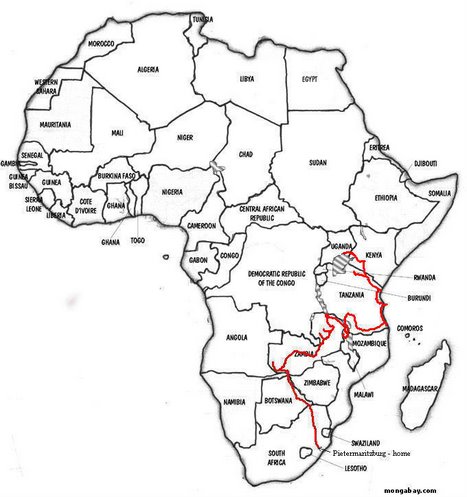
Our route
Monday, November 5, 2007

Wednesday, October 24, 2007
Sicily
Sunday 21st October 2007 B&B Capricci D'Arte Nicolisi, Sicily
Over 'breakfast' of a lousy biscuit and a jug of ice-cold milk to mix with three teaspoons of strong hot liquid coffee, Salvatore taught me a bit of Italian. He then brought a croissant which was worse than the biscuit!
So yesterday I thought we were in Nicolosi, and all the time we were in Nicosia. No wonder I felt lost and miserable, I felt I couldn't trust the map or the GPS. It is very difficult to navigate as the names are in Italian or French on the signposts and different on the map. (Like Venice is Venizia or similar). We of course don't go along the easy freeways, but meander through the villages and farmlands, so it is easy to get lost.
Through a flatish valley were ripening oranges, grape vines in their autumn colours and wheat just germinating. Today we headed for Etna (again!). It was shrouded in cloud, as expected, and as we neared the cable car area it started to rain, then sleet, then snow. The snow settled all around and on the lava ash and stone and was quite beautiful. We had a lovely cup of coffee (latte) and watched a video on the eruptions (last one in 2001). The areas not effected by recent lava and ash were covered in chestnut trees and, being Sunday, the Sicillians were out in force with their families collecting the ripe chestnut fruit.
The clouds and mist lifted long enough for a magnificent view down the mountain towards Catania city on the coast and Italy in the distance over the Med.
As it is still cold and rainy we are staying in another B&B, in Nicolosi this time.
Saturday 20th October 2007 B&B Casa Albergo, Agira, Sicily
We traveled towards Mount Etna, the smoldering volcano (which has been calculated to be overdue for eruption).
Nev says that I can now put in this following paragraph:
The villages were either nestled in the valleys below precipitous cliffs along the rocky shoreline, or, inland, perched on the top of steep hills. The wrought iron balconies protruded giddily over the retaining walls which bind the houses like bandages keeping the ancient five-story dwellings from falling down the mountains. At the very summit, pride of place, a medieval castle takes an organic form as if in growing, it bled houses down the mountainside, slowly engulfing the chequered farmlands in the valleys below.
How is that?
We had been warned that Mount Etna could be shrouded in cloud for days at this time of the year, and since it was, and it also had started to rain, we headed for the coast, finding this lovely B&B of Salvatore, on the way in Agira. It is pouring with freezing rain now and I am very glad to be snug and dry in the room. For supper Salvatore said he would take us to a pizza place in the village, but instead we landed up in an agricultural hall like a mini Royal Show. This language thing is really difficult. After the designated time, hungry and munching on very salty garlic salami which we had managed to buy at the show, he asked us if we had enjoyed our meal. We were then able to explain somehow that we hadn't eaten, and he then took us to a pizza place, driving through the alleyways in the dark and wet, hitting other car's mirrors on the way. Landy would never have made it, she is far too wide. She had to make a six-point turn to make it down his very steep, curved driveway.) Some of the houses had been hewn out of the stone cliffs, like troglodytes but have beautiful facades to fit in with the general architecture of the village. Landy was very proud to have negotiated al the tight curves, steep hills and narrow allies in Nicosia, but sometimes did go over the white lines and nearly hit the wall on the other side, stopping the oncoming traffic. Luckily Landy is deaf and didn't hear the hooting.
The farmers here grow olives and plough up and down the steep mountains in preparation for the winter, probably wheat.
Friday 19th October 2007 Caravan Site, Sicily
There was no problem entering the ferry and it left an hour or two late. We were lucky to have arrived there early, as having not booked a cabin we had to find a place to lie down and sleep. We were expecting another Wadi Halfa ferry but this was sparkling clean, and very 'first world'. We found a padded bench and stretched out for the night. We woke to the sun rising over the cliffs of Sicily on our right. The passengers who had arrived later slept on the floor, chairs or on the window sills. It was only ¼ full. We had to go through passport control (which took nearly 2 hours) on the ferry, like Aswan, but nothing for the Landy which we just drove off and onto dry land.
Palermo was the worst driving experience so far. The streets are very narrow, there are thousands of tiny cars and everyone double parks, leaving one lane open for two way traffic. We watch in amazement how when they parked their cars they nudged and bumped each other to squeeze into a parking place. We walked down the line of parked cars and more than 50% had been dinged both back and front (which made them even smaller than they actually were!). There are many (unmarked on the map) one-way streets and navigating is a nightmare. Most of the left-hand streets have no-entry signs (no problem for the locals, they go up them) and we ended up going in circles getting further and further away from where we wanted to go. Eventually we found a parking and walked around the city. We started to get city-phobic and headed out eastwards along the coast, Nev muttering that if this is what Europe is like we will be getting home sooner than planned as this isn't fun.
Once we were out of the city we relaxed and took in the scenery and went through several small villages along the coast and there is no flat land around.
We landed up at the campsite and guess who arrived - the Swiss cyclists Corina and Daniel, whom we had last seen in Cairo. They were traveling in the opposite direction to us (towards Palermo) and had been to Greece and Italy while we had been in Libya and Tunisia.
We had a nice catch-up over pizza and ice cream.
Over 'breakfast' of a lousy biscuit and a jug of ice-cold milk to mix with three teaspoons of strong hot liquid coffee, Salvatore taught me a bit of Italian. He then brought a croissant which was worse than the biscuit!
So yesterday I thought we were in Nicolosi, and all the time we were in Nicosia. No wonder I felt lost and miserable, I felt I couldn't trust the map or the GPS. It is very difficult to navigate as the names are in Italian or French on the signposts and different on the map. (Like Venice is Venizia or similar). We of course don't go along the easy freeways, but meander through the villages and farmlands, so it is easy to get lost.
Through a flatish valley were ripening oranges, grape vines in their autumn colours and wheat just germinating. Today we headed for Etna (again!). It was shrouded in cloud, as expected, and as we neared the cable car area it started to rain, then sleet, then snow. The snow settled all around and on the lava ash and stone and was quite beautiful. We had a lovely cup of coffee (latte) and watched a video on the eruptions (last one in 2001). The areas not effected by recent lava and ash were covered in chestnut trees and, being Sunday, the Sicillians were out in force with their families collecting the ripe chestnut fruit.
The clouds and mist lifted long enough for a magnificent view down the mountain towards Catania city on the coast and Italy in the distance over the Med.
As it is still cold and rainy we are staying in another B&B, in Nicolosi this time.
Saturday 20th October 2007 B&B Casa Albergo, Agira, Sicily
We traveled towards Mount Etna, the smoldering volcano (which has been calculated to be overdue for eruption).
Nev says that I can now put in this following paragraph:
The villages were either nestled in the valleys below precipitous cliffs along the rocky shoreline, or, inland, perched on the top of steep hills. The wrought iron balconies protruded giddily over the retaining walls which bind the houses like bandages keeping the ancient five-story dwellings from falling down the mountains. At the very summit, pride of place, a medieval castle takes an organic form as if in growing, it bled houses down the mountainside, slowly engulfing the chequered farmlands in the valleys below.
How is that?
We had been warned that Mount Etna could be shrouded in cloud for days at this time of the year, and since it was, and it also had started to rain, we headed for the coast, finding this lovely B&B of Salvatore, on the way in Agira. It is pouring with freezing rain now and I am very glad to be snug and dry in the room. For supper Salvatore said he would take us to a pizza place in the village, but instead we landed up in an agricultural hall like a mini Royal Show. This language thing is really difficult. After the designated time, hungry and munching on very salty garlic salami which we had managed to buy at the show, he asked us if we had enjoyed our meal. We were then able to explain somehow that we hadn't eaten, and he then took us to a pizza place, driving through the alleyways in the dark and wet, hitting other car's mirrors on the way. Landy would never have made it, she is far too wide. She had to make a six-point turn to make it down his very steep, curved driveway.) Some of the houses had been hewn out of the stone cliffs, like troglodytes but have beautiful facades to fit in with the general architecture of the village. Landy was very proud to have negotiated al the tight curves, steep hills and narrow allies in Nicosia, but sometimes did go over the white lines and nearly hit the wall on the other side, stopping the oncoming traffic. Luckily Landy is deaf and didn't hear the hooting.
The farmers here grow olives and plough up and down the steep mountains in preparation for the winter, probably wheat.
Friday 19th October 2007 Caravan Site, Sicily
There was no problem entering the ferry and it left an hour or two late. We were lucky to have arrived there early, as having not booked a cabin we had to find a place to lie down and sleep. We were expecting another Wadi Halfa ferry but this was sparkling clean, and very 'first world'. We found a padded bench and stretched out for the night. We woke to the sun rising over the cliffs of Sicily on our right. The passengers who had arrived later slept on the floor, chairs or on the window sills. It was only ¼ full. We had to go through passport control (which took nearly 2 hours) on the ferry, like Aswan, but nothing for the Landy which we just drove off and onto dry land.
Palermo was the worst driving experience so far. The streets are very narrow, there are thousands of tiny cars and everyone double parks, leaving one lane open for two way traffic. We watch in amazement how when they parked their cars they nudged and bumped each other to squeeze into a parking place. We walked down the line of parked cars and more than 50% had been dinged both back and front (which made them even smaller than they actually were!). There are many (unmarked on the map) one-way streets and navigating is a nightmare. Most of the left-hand streets have no-entry signs (no problem for the locals, they go up them) and we ended up going in circles getting further and further away from where we wanted to go. Eventually we found a parking and walked around the city. We started to get city-phobic and headed out eastwards along the coast, Nev muttering that if this is what Europe is like we will be getting home sooner than planned as this isn't fun.
Once we were out of the city we relaxed and took in the scenery and went through several small villages along the coast and there is no flat land around.
We landed up at the campsite and guess who arrived - the Swiss cyclists Corina and Daniel, whom we had last seen in Cairo. They were traveling in the opposite direction to us (towards Palermo) and had been to Greece and Italy while we had been in Libya and Tunisia.
We had a nice catch-up over pizza and ice cream.
Thursday, October 18, 2007
Last BLOG from Africa
Thursday 18th October 2007 Ferry to Palermo Sicily
On the way to Tunis we passed through lovely flat farms, some irrigated where they are growing tomatoes, onion and the main crop being grapes, wheat and pomegranates. We drove straight to the ferry terminal to book for the crossing. It was 10.30 but nothing was open yet. At 11.15 they opened and even with Ahmed's assistance it took us an hour to get done. We intend to spend a lazy day in Tunis before boarding the ferry tonight at 8pm for the overnight trip. Ahmed says it will leave an hour or two late. This is after all Africa.
We don't have much more of Africa to see (this trip) and are looking forward to the bonus European section, half sorry to leave this wonderful and diverse continent which has taught us so much about people – others as well as ourselves and each other.
Wednesday 17th October 2007 Pomegranate Orchard Camp near Testour, Tunisia
We left the yacht club and traveled through semi mountainous terrain and a lot of poor farming. Cork Trees and Oaks covered the steep hills and gradually gave way to conifers, mainly Elliotii type pine trees, but short and stubby. The ground flattened with beautiful soils, irrigation with pivots and "T"&P (T=Tunisian) and traveling irrigation watering mainly wheat and lucerne. On the flats we found a large dairy farm which we visited. They milk 500 cows all in barns on a deep litter system using wheat straw as bedding. The cows (Frieslands) were good, but their feet were suffering as the passages hadn't been cleaned for days. They had a herringbone parlour and a large bulk tank. Most of the milk we have seen so far has been transported on bakkies between 2 and 10 cans per farmer. The cows were being fed wheat silage, which had to been chopped, maize silage again which hadn't been chopped finely with half-cobs in the silage, and green lucerne, also long chop. Our French was not good enough to distinguish between whether they averaged 30l or peaked at 30l.
We then proceeded towards Dougga which was in inland Roman city from early BC. Subsequent invasions by Ottomans, Vandalls, Berber etc have left their mark, but it is remarkable for the wonderful state of preservation of the whole town. The guide's family house had been built on top of the soil covering the ruins, and the families had to be relocated by Unesco once excavation was initiated in the 1960s.
Again the drainage, water-borne sewerage and piped water to every house from 12Km away through a system of reservoirs and then lead pipes into the houses amazed us.
We then headed for a campsite. We asked a farmer and he led us into a pomegranate orchard. We had to go over his plastic irrigation pipes.
At first Nev refused, but he was insistent in his 'no problem" response (the only English words they know), and only once we were in situ and he had brought us a whole lot of pomegranates that we thought (worried) that maybe he didn't like his neighbour and let us run over his neighbour's irrigation pipes, given us all his neighbour's pomegranates and we were hoping the neighbour wouldn't appear to find us scoffing his fruit, squashing his pipes and making ourselves at home in his orchard. However all turned out well. The farmers here have huge farms of pomegranates (we have found them a bit insipid).
On the way to Tunis we passed through lovely flat farms, some irrigated where they are growing tomatoes, onion and the main crop being grapes, wheat and pomegranates. We drove straight to the ferry terminal to book for the crossing. It was 10.30 but nothing was open yet. At 11.15 they opened and even with Ahmed's assistance it took us an hour to get done. We intend to spend a lazy day in Tunis before boarding the ferry tonight at 8pm for the overnight trip. Ahmed says it will leave an hour or two late. This is after all Africa.
We don't have much more of Africa to see (this trip) and are looking forward to the bonus European section, half sorry to leave this wonderful and diverse continent which has taught us so much about people – others as well as ourselves and each other.
Wednesday 17th October 2007 Pomegranate Orchard Camp near Testour, Tunisia
We left the yacht club and traveled through semi mountainous terrain and a lot of poor farming. Cork Trees and Oaks covered the steep hills and gradually gave way to conifers, mainly Elliotii type pine trees, but short and stubby. The ground flattened with beautiful soils, irrigation with pivots and "T"&P (T=Tunisian) and traveling irrigation watering mainly wheat and lucerne. On the flats we found a large dairy farm which we visited. They milk 500 cows all in barns on a deep litter system using wheat straw as bedding. The cows (Frieslands) were good, but their feet were suffering as the passages hadn't been cleaned for days. They had a herringbone parlour and a large bulk tank. Most of the milk we have seen so far has been transported on bakkies between 2 and 10 cans per farmer. The cows were being fed wheat silage, which had to been chopped, maize silage again which hadn't been chopped finely with half-cobs in the silage, and green lucerne, also long chop. Our French was not good enough to distinguish between whether they averaged 30l or peaked at 30l.
We then proceeded towards Dougga which was in inland Roman city from early BC. Subsequent invasions by Ottomans, Vandalls, Berber etc have left their mark, but it is remarkable for the wonderful state of preservation of the whole town. The guide's family house had been built on top of the soil covering the ruins, and the families had to be relocated by Unesco once excavation was initiated in the 1960s.
Again the drainage, water-borne sewerage and piped water to every house from 12Km away through a system of reservoirs and then lead pipes into the houses amazed us.
We then headed for a campsite. We asked a farmer and he led us into a pomegranate orchard. We had to go over his plastic irrigation pipes.
At first Nev refused, but he was insistent in his 'no problem" response (the only English words they know), and only once we were in situ and he had brought us a whole lot of pomegranates that we thought (worried) that maybe he didn't like his neighbour and let us run over his neighbour's irrigation pipes, given us all his neighbour's pomegranates and we were hoping the neighbour wouldn't appear to find us scoffing his fruit, squashing his pipes and making ourselves at home in his orchard. However all turned out well. The farmers here have huge farms of pomegranates (we have found them a bit insipid).
Tabarka, Tunisia
Tuesday 16th October 2007 Tabarka Yacht Club (39Km from Algerian border), Tunisia
The countryside west of Tunis is green rolling hills. They plant wheat right to the top of the hills (bit of erosion) and all types of vegetables, and lovely tomatoes, pomegranates (and persimmons). There is only the odd dairy cow and lots of sheep. As you get nearer the Algerian border the farming deteriorates from efficient commercial farms to badly run subsistence farms.
Tunisia has a very active rail system but the line to Algeria is not in use. Libya has no railway system at all since Dad Karg blew up the last train in Tobruk, however they are thinking about putting in a new system.
We went to shop in Biserte and a guide took us to the old quarter through Turkish, Spanish, Italian and Berber housing, all with different architecture. He showed us the saunas which are still in daily use. It was like seeing the Roman ruins in action. We had breakfast (at noon) at a Tunisian kitchen, a delicious Tuna dish. The Italians and Spanish make a living fishing here and the Berber by doing woodwork.
We then traveled west and found Tabarka, 39Km from the Algerian border. This is a beautiful town with many yachts resting from sailing round the Med, and campers from all over Europe. The natural harbour is peaceful and quiet with a huge fort overlooking the harbour.
Strange rock formations like fingers guard the harbour entrance.
Monday 15th October 2007 Biserte Tree Camp, Tunisia
Yesterday evening we camped where they recommended we should, right outside the police gymnasium. As they closed a chap approached and told us that he was the security for the police gym and he would look after us too, no problem. He went to do his prayers for half an hour, up and down bowing to Mecca. Then he offered to show us where the toilets were, and took us across the road to the ferry clubhouse. We showered, locked the Landy with a small gap near the top of the window and went to bed.
During the night Nev felt the Landy rock slightly and when he looked out the guard was nearby, so went back to sleep.
Disaster! The very nice "guard" last night, had disappeared this morning with his loot of our video and still cameras. Video had no backup, the still camera had been backed up in Egypt by Harry, thank goodness. We have to work though our feelings of disappointment.
If you thought the SAP are bad, they are brilliant compared with Tunisian police. It took us nearly two hours to get the police to take a statement. Only one in the station, and could only speak Arabic.
Only when I took out my Arabic dictionary did he suddenly start typing away on his computer. It wasn't worth the effort because he didn't even write down our contact details or the serial numbers until I insisted.
We tried to go west out of Tunis, but kept landing back in Carthage, not in a happy mood, but that riding round in circles just made us realize there are worse things in life than loosing stuff, and it made us start to laugh again.
We stopped in Biserte where Nev changed the oil and checked the Landy (in a forest) and camped in the campsite right near the beach, but it was too cold to swim. The beach was nice and sandy, but water was not as clear as in Libya. It was really cold and I used two sleeping bags to get to sleep.
Sunday 14th October 2007 harbour police camp, Tunis, Tunisia
We traveled north and the farms became more and more intensive, very neat with olive trees, peaches, apricot, pears, grapes, chillies, onions, and wheat just germinating.
We came through a few rain squalls and went straight to the port at Tunis to try to book the ferry to Palermo, Sicilly. The ferry was pulling out as we arrived, but there was another on Thursday. The people were very helpful, but the office only opened Monday because of the last holiday of Eid.
Tunis is the most beautiful city we have seen so far. Sparkling white buildings set against the blue of the gulf of Tunis, a natural harbour, with the buildings on the hills overlooking the whole bay.
We spent a lot of time looking for Carthage, and gone the "Douglas Green" directions until we decided to follow a tourist bus. So we zoomed along thinking we were going to an ancient Roman site and landed in a parking lot where Nev saw a little shuttle train about to leave.
He yelled at me to hurry and we jumped on, going where? There were little trains returning with tourists in the other direction, so we were re-assured that we were not on our way to the gallows. We chugged along and ended up in a flea market. Actually it was the Sidi Bou Said, the very old part of the city and all very prettily painted white with blue doors and windows overlooking the bay.
There are hundreds of tourists here, mostly Italian and French.
The northern part of Tunisia is more affluent than the southern area with bigger homes and newer cars, except for the farmers who are generally poor. We get a poor deal all over the world as farmers! The Muslem religion is not nearly as strictly upheld here, and most younger girls do not cover their heads, and wear modern clothing.
Saturday 13th October 2007 Farmers Kids Camp near Sousse, Tunisia
Luckily it didn't rain last night, because if it had we would have unable to cross the river bed and been stranded there for a while.
We headed north to Metlaoui where the hills were being mined for phosphates. There were conveyors for miles and miles and the mine dumps were higher than those in Johannesberg, and bigger than the existing colorful hills around the mines. The country was semi desert with only prickly pears being planted. As we drove north west the farming changed with the amount of rainfall received. At first the olives were planted 25mX20m spacing, and by the time we got to Sousse they were planted 5mX5m apart. There were also peach trees and wheat.
We went to a farmer and requested a spot to camp (they only speak French and Arabic so we are finding communication very difficult here. Especially the keyboard in the internet, where the letters are all in the wrong place and when some of them are erased with use it is impossible to type a legible sentence). One of the grandchildren could speak a bit of English and they willingly gave us a space and even took us down to the salt lake to have a look. It is so nice to hear birds calling again although there are only a few, and no wild animals except dogs.
Our clothes are starting to take a hammering, and Nev's shoes are now being tied up with baling twine since the pop-rivets have pulled out and Willy has taken his pop-rivet gun with him back south. Nev fixed my slops with super-glue. Now that Nev is out of Libya, he is into shorts again, but they are worn through and looking quite cool! Nev thinks my clothes are starting to look sexy as they are beginning to get transparent.
Soon after we had set up camp the sky turned an ugly black and a gale started to turn up the dust. We packed up the tent very fast and reorganized our Landy to sleep inside. The planes wanting to land at Sousse airport circled above us for nearly an hour waiting for the gusts to subside. Our Landy was rocked by the wind for most of the night, but we were snug and dry inside.
The countryside west of Tunis is green rolling hills. They plant wheat right to the top of the hills (bit of erosion) and all types of vegetables, and lovely tomatoes, pomegranates (and persimmons). There is only the odd dairy cow and lots of sheep. As you get nearer the Algerian border the farming deteriorates from efficient commercial farms to badly run subsistence farms.
Tunisia has a very active rail system but the line to Algeria is not in use. Libya has no railway system at all since Dad Karg blew up the last train in Tobruk, however they are thinking about putting in a new system.
We went to shop in Biserte and a guide took us to the old quarter through Turkish, Spanish, Italian and Berber housing, all with different architecture. He showed us the saunas which are still in daily use. It was like seeing the Roman ruins in action. We had breakfast (at noon) at a Tunisian kitchen, a delicious Tuna dish. The Italians and Spanish make a living fishing here and the Berber by doing woodwork.
We then traveled west and found Tabarka, 39Km from the Algerian border. This is a beautiful town with many yachts resting from sailing round the Med, and campers from all over Europe. The natural harbour is peaceful and quiet with a huge fort overlooking the harbour.
Strange rock formations like fingers guard the harbour entrance.
Monday 15th October 2007 Biserte Tree Camp, Tunisia
Yesterday evening we camped where they recommended we should, right outside the police gymnasium. As they closed a chap approached and told us that he was the security for the police gym and he would look after us too, no problem. He went to do his prayers for half an hour, up and down bowing to Mecca. Then he offered to show us where the toilets were, and took us across the road to the ferry clubhouse. We showered, locked the Landy with a small gap near the top of the window and went to bed.
During the night Nev felt the Landy rock slightly and when he looked out the guard was nearby, so went back to sleep.
Disaster! The very nice "guard" last night, had disappeared this morning with his loot of our video and still cameras. Video had no backup, the still camera had been backed up in Egypt by Harry, thank goodness. We have to work though our feelings of disappointment.
If you thought the SAP are bad, they are brilliant compared with Tunisian police. It took us nearly two hours to get the police to take a statement. Only one in the station, and could only speak Arabic.
Only when I took out my Arabic dictionary did he suddenly start typing away on his computer. It wasn't worth the effort because he didn't even write down our contact details or the serial numbers until I insisted.
We tried to go west out of Tunis, but kept landing back in Carthage, not in a happy mood, but that riding round in circles just made us realize there are worse things in life than loosing stuff, and it made us start to laugh again.
We stopped in Biserte where Nev changed the oil and checked the Landy (in a forest) and camped in the campsite right near the beach, but it was too cold to swim. The beach was nice and sandy, but water was not as clear as in Libya. It was really cold and I used two sleeping bags to get to sleep.
Sunday 14th October 2007 harbour police camp, Tunis, Tunisia
We traveled north and the farms became more and more intensive, very neat with olive trees, peaches, apricot, pears, grapes, chillies, onions, and wheat just germinating.
We came through a few rain squalls and went straight to the port at Tunis to try to book the ferry to Palermo, Sicilly. The ferry was pulling out as we arrived, but there was another on Thursday. The people were very helpful, but the office only opened Monday because of the last holiday of Eid.
Tunis is the most beautiful city we have seen so far. Sparkling white buildings set against the blue of the gulf of Tunis, a natural harbour, with the buildings on the hills overlooking the whole bay.
We spent a lot of time looking for Carthage, and gone the "Douglas Green" directions until we decided to follow a tourist bus. So we zoomed along thinking we were going to an ancient Roman site and landed in a parking lot where Nev saw a little shuttle train about to leave.
He yelled at me to hurry and we jumped on, going where? There were little trains returning with tourists in the other direction, so we were re-assured that we were not on our way to the gallows. We chugged along and ended up in a flea market. Actually it was the Sidi Bou Said, the very old part of the city and all very prettily painted white with blue doors and windows overlooking the bay.
There are hundreds of tourists here, mostly Italian and French.
The northern part of Tunisia is more affluent than the southern area with bigger homes and newer cars, except for the farmers who are generally poor. We get a poor deal all over the world as farmers! The Muslem religion is not nearly as strictly upheld here, and most younger girls do not cover their heads, and wear modern clothing.
Saturday 13th October 2007 Farmers Kids Camp near Sousse, Tunisia
Luckily it didn't rain last night, because if it had we would have unable to cross the river bed and been stranded there for a while.
We headed north to Metlaoui where the hills were being mined for phosphates. There were conveyors for miles and miles and the mine dumps were higher than those in Johannesberg, and bigger than the existing colorful hills around the mines. The country was semi desert with only prickly pears being planted. As we drove north west the farming changed with the amount of rainfall received. At first the olives were planted 25mX20m spacing, and by the time we got to Sousse they were planted 5mX5m apart. There were also peach trees and wheat.
We went to a farmer and requested a spot to camp (they only speak French and Arabic so we are finding communication very difficult here. Especially the keyboard in the internet, where the letters are all in the wrong place and when some of them are erased with use it is impossible to type a legible sentence). One of the grandchildren could speak a bit of English and they willingly gave us a space and even took us down to the salt lake to have a look. It is so nice to hear birds calling again although there are only a few, and no wild animals except dogs.
Our clothes are starting to take a hammering, and Nev's shoes are now being tied up with baling twine since the pop-rivets have pulled out and Willy has taken his pop-rivet gun with him back south. Nev fixed my slops with super-glue. Now that Nev is out of Libya, he is into shorts again, but they are worn through and looking quite cool! Nev thinks my clothes are starting to look sexy as they are beginning to get transparent.
Soon after we had set up camp the sky turned an ugly black and a gale started to turn up the dust. We packed up the tent very fast and reorganized our Landy to sleep inside. The planes wanting to land at Sousse airport circled above us for nearly an hour waiting for the gusts to subside. Our Landy was rocked by the wind for most of the night, but we were snug and dry inside.
Into Tunisia
Friday 12th October 2007 Fly/railway track Camp near Tozeur, Tunisia
Right next to three mosques with the loudspeakers calling prayers for the last day of Ramadan, Nev took a whole sleeping tablet and didn't hear the mosques waking up the Muslem men (who had partied until 2am) early in the morning for prayers. Anyway, we left early before he blew a fuse and drove to Matmata.
At Matmata the terrain is very eroded and lends itself to the local Berbers making their houses underground. They call them "troglodytes" which sounds very prehistoric, but they live very in the 21st century with satellite dishes, cell phones and a BMW parked in the entrance.
The houses are built with an entrance tunnel into an open-air courtyard. Off the courtyard several rooms have been dug into the cliff made by the courtyard. It is neat and painted white inside with a little pit toilet, kitchen, water drainage out the tunnel, and a little room for everyone. As it doesn't rain much (no rain for 5 years) all the dongas have been dammed with meter high wall to catch the soil and moisture. The hard work involved in building these walls bears fruit in the way of dates but mainly olives.
We then traveled further inland across the Great salt sea (Chott de Djarid), which is 2m above sea level and at least 50Km long and nearly as wide. The road travels straight through the middle to Tozeur and Nefta where there are millions and millions of well-farmed, neat date palms groves.
We found a secluded campsite in the desert among the tilted, salty sandstone hills which had been under the sea at some stage as there we sea shells and mineral deposits near a railway line.
Thursday 11th October 2007 Gapes, Tunisia
Two things which we also noticed about Libya is that the seashore has virtually no marine life (crabs, sea snails, sea urchins etc) except sea weed, and there is very little fishing activity on or off the shore. There are fish for sale occasionally, but very meager compared with the activity in SA.
Saleem nearly ran out of copies of the itinerary papers which he had to hand in on a regular basis at police check points.
We arrived at the border and had no trouble exiting Libya because Saleem did everything. We got a transit visa for Tunisia at the border with no problems and it only cost R100 for both.
Of course, just over every border the nature of the country is different again. Tunisia is poorer nation than Libya and the main means of transport is "skadonk" old cars, mopeds and bicycles. Donkey carts are again in evidence (none in Libya). There is a huge industry of smuggling petrol from Libya into Tunisia. All along the road for the first 200Km there are no petrol stations, but hundreds of spagpags, 20l, 10l, and 5l full of petrol for sale along the road. We don't know the price of fuel here, but we believe it is R6/l compared to Libya's 75c/l. At the check points the police were confiscating tins of oil and searching for excess petrol in the Tunisian vehicles.
They ignored us totally and we proceeded unhindered in Tunisia for a change, although there are check points every 40Km or so.
The countryside was only suitable for camels, goats and sheep and there were thousands of Ha of well-farmed olive trees sparsely spaced about 25mX20m apart. Many stores on the side of the road sell brightly decorated ceramic containers and fresh produce invitingly displayed.
We passed Bedouins who live in grass huts and general population live in poorer housing than in Libya.
We kept looking in vain for a book shop for info and a map of Tunisia, but it is the last day of Ramadan today and the shops are closed early and will be until Monday for Eid. But we are camping in a campground with other people for the first time since Khartoum, and they have given us information about where to go and what to see.
Right next to three mosques with the loudspeakers calling prayers for the last day of Ramadan, Nev took a whole sleeping tablet and didn't hear the mosques waking up the Muslem men (who had partied until 2am) early in the morning for prayers. Anyway, we left early before he blew a fuse and drove to Matmata.
At Matmata the terrain is very eroded and lends itself to the local Berbers making their houses underground. They call them "troglodytes" which sounds very prehistoric, but they live very in the 21st century with satellite dishes, cell phones and a BMW parked in the entrance.
The houses are built with an entrance tunnel into an open-air courtyard. Off the courtyard several rooms have been dug into the cliff made by the courtyard. It is neat and painted white inside with a little pit toilet, kitchen, water drainage out the tunnel, and a little room for everyone. As it doesn't rain much (no rain for 5 years) all the dongas have been dammed with meter high wall to catch the soil and moisture. The hard work involved in building these walls bears fruit in the way of dates but mainly olives.
We then traveled further inland across the Great salt sea (Chott de Djarid), which is 2m above sea level and at least 50Km long and nearly as wide. The road travels straight through the middle to Tozeur and Nefta where there are millions and millions of well-farmed, neat date palms groves.
We found a secluded campsite in the desert among the tilted, salty sandstone hills which had been under the sea at some stage as there we sea shells and mineral deposits near a railway line.
Thursday 11th October 2007 Gapes, Tunisia
Two things which we also noticed about Libya is that the seashore has virtually no marine life (crabs, sea snails, sea urchins etc) except sea weed, and there is very little fishing activity on or off the shore. There are fish for sale occasionally, but very meager compared with the activity in SA.
Saleem nearly ran out of copies of the itinerary papers which he had to hand in on a regular basis at police check points.
We arrived at the border and had no trouble exiting Libya because Saleem did everything. We got a transit visa for Tunisia at the border with no problems and it only cost R100 for both.
Of course, just over every border the nature of the country is different again. Tunisia is poorer nation than Libya and the main means of transport is "skadonk" old cars, mopeds and bicycles. Donkey carts are again in evidence (none in Libya). There is a huge industry of smuggling petrol from Libya into Tunisia. All along the road for the first 200Km there are no petrol stations, but hundreds of spagpags, 20l, 10l, and 5l full of petrol for sale along the road. We don't know the price of fuel here, but we believe it is R6/l compared to Libya's 75c/l. At the check points the police were confiscating tins of oil and searching for excess petrol in the Tunisian vehicles.
They ignored us totally and we proceeded unhindered in Tunisia for a change, although there are check points every 40Km or so.
The countryside was only suitable for camels, goats and sheep and there were thousands of Ha of well-farmed olive trees sparsely spaced about 25mX20m apart. Many stores on the side of the road sell brightly decorated ceramic containers and fresh produce invitingly displayed.
We passed Bedouins who live in grass huts and general population live in poorer housing than in Libya.
We kept looking in vain for a book shop for info and a map of Tunisia, but it is the last day of Ramadan today and the shops are closed early and will be until Monday for Eid. But we are camping in a campground with other people for the first time since Khartoum, and they have given us information about where to go and what to see.
Sabratha Ruins, Libya
10th October 2007 Sabratha ruins, Libya
We spent a peaceful night in the tour group's guest house, Dar Arkno.
Arkno Tours had efficiently managed everything through our now good friend and guide, Saleem. We walked through the Tripoli 'souk' (market) last night which opened at 9pm and didn’t close till 3am. We left the hotel at 9.30am, in very little traffic as most people surface from sleeping off the Ramadan nights at 10.30am, earliest. We proceeded west towards Sabratha through entirely populated areas and it rained for the first time since we were in Khartoum, Sudan, but only for a few minutes. One thing that "the Colonel" (Ghadaffi) has got right, is that the people here seem content, and although they may not agree with all his policies, they have a thriving economy going and he is looking after his own people in a socialist manner. 75% of the working population is employed by the government. Everyone get R20 each for basic food coupons (for sugar, oil, bread, milk, meat etc) from a government shop that sells produce at 25% cheaper than commercial shops. Local fruit and veges cost about the same as in SA. Fanta cost R5.00 for 2l. Alcohol is forbidden and crime is very minimal. The price of commodities seems to be fixed and they pride themselves that you don't have to bargain like one has to in Egypt. With fuel being cheap and cars 25% less than in SA, transport is very cheap and you can catch a taxi and go around the city for R20. We still cannot believe that we went right across Libya (2000Km) on R150 worth of fuel!!! There are many minibuses, but hardly any busses here. The population is very controlled by their strong religion claiming 100% are Muslim in this country. The houses are three-storied blocks of flats for the "middle class”. There are also many free standing houses. Everyone has a home, there are no squatters or 'houses' like Bruntville. No-one is on the street absolutely destitute and everyone has sufficient for their needs.
People earning R2500 to R5000 pay 1% tax and above that they pay a small bit more but our guide didn't think anyone paid anywhere near 10%, even in the top bracket. Government workers do not pay tax. There is no VAT.
There are no donkey carts in Libya like in all the other countries from Botswana north. Dogs are not kept as pets here but the many feral dogs go around in packs at night hunting and barking. Another strange thing we have found in the Libyan coastal route is that there are no wild animals and virtually no birds, not even seagulls. We have seen three herons, some egrets, a few mossies, crows and a few unidentified starling type birds and that's it!
The only problem we saw was the garbage disposal, or lack thereof. Plastic bags, bottles and everything that animals (dogs, cats, camels, sheep and goats) cannot eat gets blown around by the wind. The beaches are littered, the roadsides are littered, and the Libyans just don't see it. Their rich archeological sites are being spoilt by the lack of tourist control.
We walked around Sabratha, another ancient Roman settlement destroyed in 365AD earthquake, not as good as Leptis Magna but still fascinating with their drainage, water borne sewerage, toilets, magnificent temples, saunas, baths and general living. There were a surprisingly high number of tourists here, up to six bus loads.
We drove around the town, stocked up with lamb (R55/Kg), chicken (R25/Kg) and camel meat (R45), (beef is R50/Kg) fruit and veges for the next few days. We had stewed camel meat tonight which was quite delicious.
We are camping in a site again within sight of the lit-up ruins, and the deep blue Mediterranean Sea.
Tuesday 9th October 2007 Dar Arkno Guest house, Tripoli, Libya
We went to the museum next to the site this morning. A very well presented and well preserved place and we spent 2hours reading the way they found the various buildings. Archeologists were outside covered in white dust, restoring a huge column to its former glory.
Archeology is such an exacting, slow-moving, detailed science. Nev would have lost patience and gone in with a front-end loader to dig up what was there!!
We went to the amphitheatre about 1Km away overlooking the sea. It was designed then as Kings Park Stadium is designed today. It was huge, still in excellent condition and held 12000people who watched the lions eating the Christians, and gladiator slaves killing each other.
Most of the area between Al Khums and Tripoli is built up. The vehicles are mostly modern with some Chinese cars apparent, (called Gonow) with double cabs and look exactly like the Toyotas and Isuzus and sell for under R100,000. Single cabs are R60,000 but look better than the "Chana" in SA.
Libyan drivers are very aggressive and drive very fast. Saleem has learned how to use our hooter and leans over me and parps the hooter while swearing out the passenger window while waving his fist at the other car!!!
Monday 8th October 2007 Leptis Magna, Al Khums, Libya
We left early and went through boring country except at Sert. This is Gadaffi's city where he is trying to set up a model city. As a result there is irrigation on the approach and the small farmers each have a huge reservoir from the "Great Manmade River" GMR, which pipes water 1000Km from the desert through 4m pipes to the coast. There is a government farm at Sert with several small center pivots (3-6 towers) along the road and everything looks lovely and green.
We arrived at Leptis Magna and spent the rest of the day exploring the ruins caused by the 365AD earthquake. This Roman and Greek city is huge and, unlike the ruins in Rome, have not been built upon, so there is an amazing area still to excavate. We were fascinated by the Hadrian's Baths, where they had saunas, huge swimming pools and exercise areas with marbled walls, mosaic floors, granite pillars and marble statues in abundance. We marveled at how little has changed in 2000 years regarding water reticulation, sewerage (flush toilets) and piped water. The stadia held 10,000 people and looked like the ABSA stadium in Durbs. We could summon up the atmosphere of old so easily as we wondered among the buildings. They used to plant olives and export olive oil to Rome, more than 1mil litres per year.
We camped in the car park overlooking the ruins (free) and had a lovely shower in their shower rooms. It rained a few spots in the night and Nev had to jump out of the tent and bring in our washing.
Sunday 7th October 2007. Rubbish Dump at Djdabiya, Libya
Today we had a looooong boring drive after waiting for Saleem to come back from having our passports registered (a la Sudan) where we have to register within a week after arriving in the country. We traveled along Karroo type country often below sea level with shallow salt lakes and herds of camels grazing the short scrub. There was also a little bit of irrigation with lucerne, dates and olives, all K&P type irrigation but not more than 100Ha.
We drove far too long as Saleem needed to get to a mosque and a restaurant, and we found one near a garbage polluted area with a camel pen on the side. I couldn't believe we were going to stay there but there was nothing better, it was getting dark and we were all tired, but I stated that we were going to leave at sunrise the next morning!
We spent a peaceful night in the tour group's guest house, Dar Arkno.
Arkno Tours had efficiently managed everything through our now good friend and guide, Saleem. We walked through the Tripoli 'souk' (market) last night which opened at 9pm and didn’t close till 3am. We left the hotel at 9.30am, in very little traffic as most people surface from sleeping off the Ramadan nights at 10.30am, earliest. We proceeded west towards Sabratha through entirely populated areas and it rained for the first time since we were in Khartoum, Sudan, but only for a few minutes. One thing that "the Colonel" (Ghadaffi) has got right, is that the people here seem content, and although they may not agree with all his policies, they have a thriving economy going and he is looking after his own people in a socialist manner. 75% of the working population is employed by the government. Everyone get R20 each for basic food coupons (for sugar, oil, bread, milk, meat etc) from a government shop that sells produce at 25% cheaper than commercial shops. Local fruit and veges cost about the same as in SA. Fanta cost R5.00 for 2l. Alcohol is forbidden and crime is very minimal. The price of commodities seems to be fixed and they pride themselves that you don't have to bargain like one has to in Egypt. With fuel being cheap and cars 25% less than in SA, transport is very cheap and you can catch a taxi and go around the city for R20. We still cannot believe that we went right across Libya (2000Km) on R150 worth of fuel!!! There are many minibuses, but hardly any busses here. The population is very controlled by their strong religion claiming 100% are Muslim in this country. The houses are three-storied blocks of flats for the "middle class”. There are also many free standing houses. Everyone has a home, there are no squatters or 'houses' like Bruntville. No-one is on the street absolutely destitute and everyone has sufficient for their needs.
People earning R2500 to R5000 pay 1% tax and above that they pay a small bit more but our guide didn't think anyone paid anywhere near 10%, even in the top bracket. Government workers do not pay tax. There is no VAT.
There are no donkey carts in Libya like in all the other countries from Botswana north. Dogs are not kept as pets here but the many feral dogs go around in packs at night hunting and barking. Another strange thing we have found in the Libyan coastal route is that there are no wild animals and virtually no birds, not even seagulls. We have seen three herons, some egrets, a few mossies, crows and a few unidentified starling type birds and that's it!
The only problem we saw was the garbage disposal, or lack thereof. Plastic bags, bottles and everything that animals (dogs, cats, camels, sheep and goats) cannot eat gets blown around by the wind. The beaches are littered, the roadsides are littered, and the Libyans just don't see it. Their rich archeological sites are being spoilt by the lack of tourist control.
We walked around Sabratha, another ancient Roman settlement destroyed in 365AD earthquake, not as good as Leptis Magna but still fascinating with their drainage, water borne sewerage, toilets, magnificent temples, saunas, baths and general living. There were a surprisingly high number of tourists here, up to six bus loads.
We drove around the town, stocked up with lamb (R55/Kg), chicken (R25/Kg) and camel meat (R45), (beef is R50/Kg) fruit and veges for the next few days. We had stewed camel meat tonight which was quite delicious.
We are camping in a site again within sight of the lit-up ruins, and the deep blue Mediterranean Sea.
Tuesday 9th October 2007 Dar Arkno Guest house, Tripoli, Libya
We went to the museum next to the site this morning. A very well presented and well preserved place and we spent 2hours reading the way they found the various buildings. Archeologists were outside covered in white dust, restoring a huge column to its former glory.
Archeology is such an exacting, slow-moving, detailed science. Nev would have lost patience and gone in with a front-end loader to dig up what was there!!
We went to the amphitheatre about 1Km away overlooking the sea. It was designed then as Kings Park Stadium is designed today. It was huge, still in excellent condition and held 12000people who watched the lions eating the Christians, and gladiator slaves killing each other.
Most of the area between Al Khums and Tripoli is built up. The vehicles are mostly modern with some Chinese cars apparent, (called Gonow) with double cabs and look exactly like the Toyotas and Isuzus and sell for under R100,000. Single cabs are R60,000 but look better than the "Chana" in SA.
Libyan drivers are very aggressive and drive very fast. Saleem has learned how to use our hooter and leans over me and parps the hooter while swearing out the passenger window while waving his fist at the other car!!!
Monday 8th October 2007 Leptis Magna, Al Khums, Libya
We left early and went through boring country except at Sert. This is Gadaffi's city where he is trying to set up a model city. As a result there is irrigation on the approach and the small farmers each have a huge reservoir from the "Great Manmade River" GMR, which pipes water 1000Km from the desert through 4m pipes to the coast. There is a government farm at Sert with several small center pivots (3-6 towers) along the road and everything looks lovely and green.
We arrived at Leptis Magna and spent the rest of the day exploring the ruins caused by the 365AD earthquake. This Roman and Greek city is huge and, unlike the ruins in Rome, have not been built upon, so there is an amazing area still to excavate. We were fascinated by the Hadrian's Baths, where they had saunas, huge swimming pools and exercise areas with marbled walls, mosaic floors, granite pillars and marble statues in abundance. We marveled at how little has changed in 2000 years regarding water reticulation, sewerage (flush toilets) and piped water. The stadia held 10,000 people and looked like the ABSA stadium in Durbs. We could summon up the atmosphere of old so easily as we wondered among the buildings. They used to plant olives and export olive oil to Rome, more than 1mil litres per year.
We camped in the car park overlooking the ruins (free) and had a lovely shower in their shower rooms. It rained a few spots in the night and Nev had to jump out of the tent and bring in our washing.
Sunday 7th October 2007. Rubbish Dump at Djdabiya, Libya
Today we had a looooong boring drive after waiting for Saleem to come back from having our passports registered (a la Sudan) where we have to register within a week after arriving in the country. We traveled along Karroo type country often below sea level with shallow salt lakes and herds of camels grazing the short scrub. There was also a little bit of irrigation with lucerne, dates and olives, all K&P type irrigation but not more than 100Ha.
We drove far too long as Saleem needed to get to a mosque and a restaurant, and we found one near a garbage polluted area with a camel pen on the side. I couldn't believe we were going to stay there but there was nothing better, it was getting dark and we were all tired, but I stated that we were going to leave at sunrise the next morning!
Sunday, October 7, 2007
Into Libya
Saturday 6th October 2007 New Restaurant Grounds.
We headed for Benghazi, the most westerly place Dad Karg had got to in the war. It is a huge city, second biggest in Libya.
We walked around the market and there are 100s of jewelry shops and clothing shops there. The women apparently wear lots and lots of jewelry hidden under their black outer clothing. 100% of Libyans are Muslem and if anyone breaks Ramadan by eating or drinking during the daytime, they are shunned, called liars, and not trusted thereafter, apart from it being a very bad sin.
It is well laid out with an extensive network of roads and modern flyovers.
It is also just west of the fertile, cultivated area of the "Green Mountain" where they grow wheat, apples (the sweetest we have ever eaten), peaches, grapes, and farm honey. The lands are beautiful and flat at an altitude of 600m, and looks a bit like the Freestate.
West of the town starts to look more and more like the Karroo with little shrubs and shorter trees. The whole area is short of rain. The towns have desalination plants for water. Libya has found a huge underground water supply 1000Km inland, the volume is equal to the whole of the Nile flowing into a hole for 200 years. They are busy making 2 X 1000Km long artificial rivers to bring this water towards the coast.
The roads in Libya are very good, not as good as in Egypt, and much more traffic which drives faster and more aggressively. Diesel costs 75c/l and 90c/l in Egypt. 1Dinar (Libyan) = R5.00, and the price of goods is about the same as in SA except bread which is much cheaper.
The most common car is the Merc Vito. The taxis are old Mazda 323 and we get recognised as foreign and greeted with a hoot as there are not many foreign cars in Libya.
Again we have been accommodated in a back yard free of charge. This time in the grounds of a new restaurant with a hot shower, kitchen and near an eating place for Saleem to do his Ramadan thing.
Friday 5th October 2007 Hotel Grounds Camp
During the night the wind got up, and as you know, sand dunes move!! We had these horrible thoughts of waking up under a sand dune. It wasn't that bad, but there was sand everywhere! We dusted off and headed for Cyrene, explored the ruins of Monepolis at the beach, the temple of Zeus and the Greek tombs and the old city. The Romans were here just before AD and the Greeks soon thereafter and left their marks of temples, acropolises and amphitheatres like those in Rome and Greece, (now without the tourists).
The Libyan’s are very friendly and hospitable people, offering tea, food and hospitality all the time. That evening we camped in the hotel grounds (free again)
Thursday 4th October 2007 Tobruk - sandy dune beach camp
Woke up anticipating a day of hell getting ourselves and the Landy out of Egypt and into Libya. We got to the border at 7am and had to wake up the first man as he had been awake all night due to Ramadan. The Muslems eat breakfast at about 6pm then dinner at 7pm then another meal at 3am. Then prayers and fall asleep at 4am expecting to sleep till 10 or 11am. The first man then sent us to the licensing department, a big empty building where we walked around shouting Hulooooo and Sallaaaaam for a few echoing minutes. We were wondering what to do next and I started to knock loudly on the counter window and nearly jumped out of my skin when a blanket on the counter came to life and out poked a sleepy head. He was so groggy with sleep that he could only grunt, snort and point. We got the message and handed over the number plates and license and were through the border having paid R7 in total and in only 30 minutes.
Our guide for Libya, Saleem was only expected at 9pm, and although it was slow, we got through the border and into Libya without incident and headed towards Tobruk where Dad Karg had escaped from the Germans in WWII.
We saw the excellently kept war memorial and drove around the nice town, then headed west to find a campsite for the night. Saleem was required to hand in an itinerary paper at each check point, but missed one. We were traveling along merrily when we were pulled over by security and we thought we had done something wrong. He requested the form, and was very friendly and offered Saleem Ramadan breakfast with his family and directed us to a sand dune next to a deserted beach to camp. Just what we were wanting to do.
Wednesday 3rd October 2007 Near Soluum Beach
We proceeded west to Soluum. More and more fig trees planted indicating how drought resistant this variety is as there are 100s of Ha of them. Nearly all the main roads in Egypt are double highways and are in excellent condition which makes for very easy driving. After reaching El Soluum we drove up to the border post to see when it opened the next morning – open 24 hours a day. We then found a camp spot near the beach with the approval of an official. We didn't set up camp in anticipation of being told to move and sure enough two army guys came along and told us, big problem, and politely told us to move to the other side of the road, which we did.
Tuesday 2nd October 2007 Noisy Quarry
Left Merza Mertruh and headed west along flat countryside next to the sea where the land had been cultivated for crops in preparation for the rainy two months Nov and Dec. Palm trees and olive trees had given way to the odd fig orchard. We found a campsite next to the road behind a quarry as we didn't want to camp on someone's cultivated land.
We headed for Benghazi, the most westerly place Dad Karg had got to in the war. It is a huge city, second biggest in Libya.
We walked around the market and there are 100s of jewelry shops and clothing shops there. The women apparently wear lots and lots of jewelry hidden under their black outer clothing. 100% of Libyans are Muslem and if anyone breaks Ramadan by eating or drinking during the daytime, they are shunned, called liars, and not trusted thereafter, apart from it being a very bad sin.
It is well laid out with an extensive network of roads and modern flyovers.
It is also just west of the fertile, cultivated area of the "Green Mountain" where they grow wheat, apples (the sweetest we have ever eaten), peaches, grapes, and farm honey. The lands are beautiful and flat at an altitude of 600m, and looks a bit like the Freestate.
West of the town starts to look more and more like the Karroo with little shrubs and shorter trees. The whole area is short of rain. The towns have desalination plants for water. Libya has found a huge underground water supply 1000Km inland, the volume is equal to the whole of the Nile flowing into a hole for 200 years. They are busy making 2 X 1000Km long artificial rivers to bring this water towards the coast.
The roads in Libya are very good, not as good as in Egypt, and much more traffic which drives faster and more aggressively. Diesel costs 75c/l and 90c/l in Egypt. 1Dinar (Libyan) = R5.00, and the price of goods is about the same as in SA except bread which is much cheaper.
The most common car is the Merc Vito. The taxis are old Mazda 323 and we get recognised as foreign and greeted with a hoot as there are not many foreign cars in Libya.
Again we have been accommodated in a back yard free of charge. This time in the grounds of a new restaurant with a hot shower, kitchen and near an eating place for Saleem to do his Ramadan thing.
Friday 5th October 2007 Hotel Grounds Camp
During the night the wind got up, and as you know, sand dunes move!! We had these horrible thoughts of waking up under a sand dune. It wasn't that bad, but there was sand everywhere! We dusted off and headed for Cyrene, explored the ruins of Monepolis at the beach, the temple of Zeus and the Greek tombs and the old city. The Romans were here just before AD and the Greeks soon thereafter and left their marks of temples, acropolises and amphitheatres like those in Rome and Greece, (now without the tourists).
The Libyan’s are very friendly and hospitable people, offering tea, food and hospitality all the time. That evening we camped in the hotel grounds (free again)
Thursday 4th October 2007 Tobruk - sandy dune beach camp
Woke up anticipating a day of hell getting ourselves and the Landy out of Egypt and into Libya. We got to the border at 7am and had to wake up the first man as he had been awake all night due to Ramadan. The Muslems eat breakfast at about 6pm then dinner at 7pm then another meal at 3am. Then prayers and fall asleep at 4am expecting to sleep till 10 or 11am. The first man then sent us to the licensing department, a big empty building where we walked around shouting Hulooooo and Sallaaaaam for a few echoing minutes. We were wondering what to do next and I started to knock loudly on the counter window and nearly jumped out of my skin when a blanket on the counter came to life and out poked a sleepy head. He was so groggy with sleep that he could only grunt, snort and point. We got the message and handed over the number plates and license and were through the border having paid R7 in total and in only 30 minutes.
Our guide for Libya, Saleem was only expected at 9pm, and although it was slow, we got through the border and into Libya without incident and headed towards Tobruk where Dad Karg had escaped from the Germans in WWII.
We saw the excellently kept war memorial and drove around the nice town, then headed west to find a campsite for the night. Saleem was required to hand in an itinerary paper at each check point, but missed one. We were traveling along merrily when we were pulled over by security and we thought we had done something wrong. He requested the form, and was very friendly and offered Saleem Ramadan breakfast with his family and directed us to a sand dune next to a deserted beach to camp. Just what we were wanting to do.
Wednesday 3rd October 2007 Near Soluum Beach
We proceeded west to Soluum. More and more fig trees planted indicating how drought resistant this variety is as there are 100s of Ha of them. Nearly all the main roads in Egypt are double highways and are in excellent condition which makes for very easy driving. After reaching El Soluum we drove up to the border post to see when it opened the next morning – open 24 hours a day. We then found a camp spot near the beach with the approval of an official. We didn't set up camp in anticipation of being told to move and sure enough two army guys came along and told us, big problem, and politely told us to move to the other side of the road, which we did.
Tuesday 2nd October 2007 Noisy Quarry
Left Merza Mertruh and headed west along flat countryside next to the sea where the land had been cultivated for crops in preparation for the rainy two months Nov and Dec. Palm trees and olive trees had given way to the odd fig orchard. We found a campsite next to the road behind a quarry as we didn't want to camp on someone's cultivated land.
Subscribe to:
Posts (Atom)